Showing posts sorted by relevance for query brahms. Sort by date Show all posts

January 22, 2010

Meet Mr. Brahms

In yesterday's post, we said that we going to address why Philharmonia Baroque is expanding it's repertoire to play works from 1858 and 1878, some of the newest music we've ever played, but not quite. First, however, let's talk about the beloved Romantic composer of these works: Johannes Brahms. Violinist and Philharmonia Baroque staffer David Wilson joins us again:

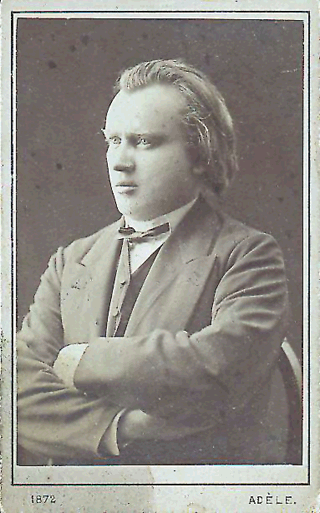
When Johannes Brahms (pictured left) was born in 1833, his native city of Hamburg already had a musical tradition that was centuries old. Opera, church music and music publishing all thrived throughout the 17th and 18th centuries. The city also had a tradition of public concerts – something we take for granted today but was not a given throughout history. This was the environment into which Brahms was born. His family was working class, but valued music and education. Brahms went to school and had lessons on piano, cello and horn. As a teenager, he began to perform in public as a pianist and to write music.

At the age of 20, Brahms was meeting and playing music with many musicians who were or would become some of the foremost performers and composers of their time, including violinist Joseph Joachim, for whom Brahms would later write his only violin concerto, and Franz Liszt. Joachim told Brahms that he really should get to know the Schumanns, Robert and Clara, both of whom were composers. He did so in September of 1853 and a lifelong friendship between the three musicians began. Brahms spent the next ten years performing, composing chamber music and thinking about the creative process and how that relates to life.

In 1855, frustrated with composition to the point of writing that he no longer had any idea how one goes about composing music, he turned to early music – the counterpoint of Bach, for example, and to baroque and renaissance dance forms – as well as folk music for creative inspiration. It worked. (In our time, Estonian composer Arvo Pärt reached a similar creative impasse and, like Brahms, he resolved it through a study and application of the principles of early music.) Brahms’s interest in early music was also reflected in the repertoire he chose for the choirs and orchestras he conducted in Hamburg and Vienna, as well as the repertoire he performed in his piano recitals. In 1850, the Bach-Gesellschaft (Bach Society) was formed in Germany to publish the complete works of J.S. Bach. Brahms owned a number of volumes (cantatas) of that complete-works edition and may even have been a subscriber of the Society.

In 1869, the first full performance of his German Requiem was greeted so enthusiastically that Brahms finally became known as an important composer throughout Europe. Despite a disastrous stock market collapse in 1873 that trashed the economies of most European countries (and that of the U.S.), Brahms’s own fortunes soared in the 1870s in the form of concert tours, guest conducting engagements throughout Europe, awards and knighthoods, publishing contracts and teaching engagements. He continued to compose in many genres, including large works involving orchestra.

Brahms died of liver cancer on April 3, 1897. Although he was romantically linked to a number of women during his lifetime, he never married.


January 28, 2010

Nic on performing Brahms: Pt. 2

We don't know if you saw it, but Jonathan Rhodes Lee wrote a great preview of February's concert on San Francisco Classical Voice. In the article, he posed the question: "Will we hear the concerto as Joachim played it? As Brahms would have wanted it heard? As we want him to have wanted it heard? Or as we want it heard following our own standards?" Well, here is Nic's second post to answer that very question:

Here are a few thoughts on the instruments the orchestra will be playing in February:

Strings –

By Brahms’ time the violin, viola and cello had an essentially modern set up, with an angled-back neck and correspondingly higher bridge.

On the violin, gut D, A and E strings were the norm at least until about 1920. A silver or copper-wound G string was usual. Louis Spohr claimed to have invented the chin rest around 1820 to make large shifts in the position of the left hand easier; Spohr’s centrally placed chin rest was widely but by no means universally used. By 1850, the chin rest had migrated to its present position to the left of the tailpiece.

For cellists, the spike or endpin came into use in the 1860’s but many players, including Alfredo Piatti, the cellist of Joseph Joachim’s “London” quartet preferred not to use one.

Double basses usually had four strings, though Domenico Dragonetti, Beethoven’s favourite bassist, used only three. Hans von Bülow was one of the first to use a five string basses in the orchestra at Meiningen (a town in central Germany; Wagner and Brahms were both associated with this orchestra), but he did so some years after Brahms had written his Second Symphony of 1877, where in Bar 13 of the opening movement he writes a rest rather than a low D#; most basses could not yet play that note.

Dragonetti, Robert Linley and John Loder. Edinburgh before 1846.

Winds and brass –

The cylindrical bore flute with the Boehm key system was introduced in 1847, but was slow to gain acceptance. Brahms’ favourite flautist, Franz Doppler, did not play one in the Vienna Philharmonic. Indeed they were banned from certain orchestras until 1914.

Brahms considered that the level of clarinet playing had generally gone down during his lifetime with the notable exception of Richard Mühlfeld of the Meiningen Orchestra. He played Baermann system instruments made of boxwood.

Mühlfeld's clarinets

Brahms wrote his Trio for horn, violin and piano (Opus 40) for the old Waldhorn (a valveless natural horn) but he would have been hard pressed to find one in an orchestra. The Vienna Philharmonic used the Pumpenhorn (a Viennese horn with three valves), which came in after about 1850.


January 25, 2010

Nic on performing Brahms: Part 1

We are excited to post Music Director Nic McGegan's first blog entry for A415 today! This is the first of a series of posts about our February concerts.


As we all know, Philharmonia Baroque is starting the New Year with a voyage into what, for our orchestra, will be uncharted waters: performing the music of Johannes Brahms (pictured left). It promises to be a fascinating and thrilling adventure both for the orchestra and, we hope, for you the listener.

The performance of later Romantic music on period instruments is becoming relatively commonplace in Europe, but, here in the U.S.A., it is much more of a rara avis, at least in the concert hall. I thought that it might be fun for me, as a kind of New Year’s resolution, to jot down some thoughts about how the orchestra might approach the performance of Brahms on period instruments.

Historically-informed performance consists of two basic elements: using period instruments and playing them in what we, perhaps fondly, hope is an appropriate style. For the performance of music before about 1830, both elements have to be combined. After that watershed date, the instruments start to resemble modern ones, but the style of performance differed in many important ways to what one might hear at a modern symphony concert. Our sources on the performance of earlier music are treatises, descriptions and pictures. For music from Brahms onwards, a new source comes into play, namely sound recordings. There is even one of Brahms himself, though, apart from his spoken introduction in a remarkably high, almost squeaky voice, it is impossible to hear much through the miasma of scratches.

For Brahms’ music, we are lucky to have five recordings by his friend, violinist Joseph Joachim, from 1903, plus recorded performances by players and conductors who knew or studied with him. Anyone who wants to delve into this more deeply can read an excellent book called Performing Brahms, edited by Michael Musgrave and Bernard Sherman. There is even a CD with the book with all the Joachim recordings, the one of Brahms himself, piano students of his and Clara Schumann and much more besides.

Stay tuned for more posts in the coming weeks...

February 8, 2010

Nic on performing Brahms: Pt. 4

Nic continues his post about the style that the orchestra will perform Brahms in this week:

Tempo –

Brahms was notoriously metronome-averse, so neither of the pieces that we will be playing are provided with metronome markings. Joachim, however, had no such qualms, and his edition of the Violin Concerto (1910) does have them. In the German edition of Joachim’s Violinschule (1905), which contains the violin part of the concerto, there are faster markings than in the 1910 edition; those are given here in parenthesis. They are:

Mvt. 1. Quarter note =120 (126).

Mvt. 2 Eighth note = 72

Mvt. 3 Quarter note = 96 (104). Poco più presto, Quarter note = 120 (132)

These however are not to be thought of as tempi that apply to a complete movement. There is plenty of evidence to show that Brahms, like many of his time, preferred a very flexible approach to speed. The orchestra will try this, at least in the Serenade. There is a wide variation in the overall timings of some Brahms’ Symphonies from one performance to another. For example, Symphony No. 1 was performed in 37 minutes by Hans von Bülow and the Meiningen Orchestra in 1884, compared to Carlo Maria Giulini and the L.A. Philharmonic in 1981 at slightly over 49 minutes.

Pitch –

We will be tuning to A-440. When touring, Richard Mühlfeld would send a tuning fork ahead to the next venue so that the piano could be tuned to the right pitch. His fork was at A-440. This was, however, by no means the universal pitch at the time. ‘Pitch battles’ were fought all over Europe between instrumentalists, who favoured a higher pitch, and opera companies, whose singers tried to keep the pitch lower. Often such a war would go on within the same city as in London. Pitch could vary from somewhere in the 420’s to the mid 450’s. So 440 seems a reasonable compromise!

Phrasing –

Fritz Steinbach, the conductor of the Meiningen orchestra from 1886 to 1903, used to play the opening of Brahms’ Second Symphony with audible gaps between the slurs. He modelled his performance practice style on that of the composer. Such phrasing was also discussed in letters between Brahms and Joachim in 1879. See the marks below.


Stay tuned, Nic's final post will be about the most radical change for the orchestra this set: orchestra size and arrangement.

February 10, 2010

Nic on performing Brahms: Pt. 5

Nic is back for his final post! Want to learn more about performing Brahms on period instruments? Listen to our audio preview, featuring Nic, string player Maria Caswell and host Teddy Wing. Now, here is Nic on orchestra arrangement – you may be surprised to see where your favorite musicians are sitting at our upcoming concerts:


Orchestra size and arrangement –

In Brahms’ time, as in earlier periods, the size of orchestras varied widely. Brahms himself seems to have preferred intimate halls with relatively small forces. The Meiningen orchestra had 48 members and the orchestra in Karlsruhe, which gave the first performance of the 1st Symphony, had 49 members. The string count was 9 first violins, 9 second violins, 4 violas, 4 cellos, and 4 basses.

Many German orchestras continued to perform concerts standing. In 1893, one of the members of the Leipzig Gewandhaus Orchestra was quoted as saying: “In the Gewandhaus we are wholly different people than in the theatre; in a black dress coat and standing erect at the desk…a different higher spirit dominates us.” The Meiningen orchestra under von Bülow (with the young Richard Strauss as his assistant) also played standing. The orchestra will probably sit, since we’ll be playing a substantial concerto, but it might be interesting to try it out.

Georg Henschel, when he took charge of the newly founded Boston Symphony in 1881, sent Brahms a couple of seating plans for his approval. Here is the one the composer favoured, the one the orchestra will be giving a try:


Thank you for reading, I hope that you will enjoy our concerts. For further reading, I recommend the following books:
  • Brown, Clive. 1999. Classical and Romantic Performance Practice 1750-1900. Oxford University Press.
  • Haynes, Bruce. 2002. A History of Performing Pitch (The Story of “A”). Scarecrow Press.
  • Lawson, Colin, and Robin Stowell. 1999. The Historical Performance of Music, an Introduction. Cambridge University Press.
  • Musgrave, Michael, and Bernard D. Sherman. 2003. Performing Brahms. Cambridge University Press.

February 17, 2010

What did you think about our Brahms concert?

The reviews are in and boy are they mixed.

Music director Nicholas McGegan prefaced the concert with a few words about the attempts at the historical accuracy on display... All very interesting, but the real test came in performance. And nothing affirmed the power of this approach like the splendid performance of the Serenade No. 1 in D that occupied the first half of the program... Avoiding the sleek, sometimes impersonal quality that can often seep into modern renditions, [McGegan] embraced every opportunity to give the music a musky physicality - especially in the outer movements, whose rhythmic force was arresting.
However, Rich Scheinen wrote:
Were Johannes Brahms alive to coach today's players, what instructions would he give them? How would he want his music to sound? Not the way it sounded Thursday, when conductor Nicholas McGegan and the Philharmonia Baroque Orchestra unveiled their much-ballyhooed all-Brahms program... It was one strange concert, beginning with an almost stupendously inept performance of Brahms' infrequently played Serenade No. 1 in D major... At its base line, the concert was plain uncomfortable... The orchestra sounded like a country band, raucously out of tune, with broadly sliding strings and elephantine mishaps in the winds and horns.
Both Michelle Dulak Thomson and Stephen Smoliar wrote insightful commentary on our little experiment.

However, the purpose of this blog is to ask: What did you think? Post your comments here or on Yelp.com.

Did we do Brahms tribute or detriment?

February 3, 2010

Nic on performing Brahms: Pt. 3

So we now know about how Nic researched contemporary performances of Brahms' work and we also know a little about the instruments that were likely used to play his works around the time they were composed. Let's find out about some of the smaller details about the style that Philharmonia Baroque musicians might be playing in in February:

Here are the first of a few thoughts I have about we may play Brahms in February:

Vibrato

We have the evidence of Joachim’s recordings that he perhaps used relatively little vibrato (the oscillation of pitch which instruments can produce to imitate the sound of human singing – learn more about wrist vibrato and arm vibrato). However, Fanny Davies, who heard him play the Third Piano Trio in 1887, noted that in one passage at least (marked espressivo) he used vibrato to great effect. On the other hand, as early as 1863, cellist David Popper was both praised and lampooned for his continuous vibrato. He played frequently with Brahms after 1886. Mühlfled also used vibrato on the clarinet. However, it is important to remember that these players were soloists and that orchestral players used much less, if any, vibrato. Indeed, the Vienna Philharmonic preserved an almost vibrato-less style until the Second World War. The orchestra will try to copy this with the exception of notes marked <>.

Portamento

Already in 1811, composer Antonio Salieri complained of Viennese orchestral string players using portamenti (sliding from one pitch to another). One can hear in Joachim’s recordings that he employed portamento as a soloist. His own editions and his treatise on violin playing (Violinschule) contain many examples of this practice. Of special interest for our concert is his edition of the Brahms Violin Concerto, in which he provided fingerings throughout and indicated plenty of portamenti. Early orchestral recordings offer clear evidence of the widespread use of this embellishment. Be prepared for lots of them in our concert!

Flute treatises for the pre-Boehm flute have fingering charts for portamenti. The increasing amount of keywork on later instruments made it harder to glide from note to note, but John Clinton’s Flute Treatise (A Code of Instructions for the Fingering of the Equisonant Flute by the Inventor and Patentee, 1860) shows that the practice did continue into the second half of the 19th century. As he wrote himself: "This ornament is effected by gradually drawing or sliding the fingers off the holes, instead of raising them in the usual manner; by this means is obtained all the shades of sound between the notes, so that the performer may pass from one note to another, as it were, imperceptibly; it produces a pleasing effect, when sparingly used. It is denoted by the mark [shown above the notes above]. The fingers must be drawn off the holes in a line towards the palm of the hand; the employment of the crescendo with the glide heightens the effect."

Bowing

Studies of the old orchestral material used by the Berlin and Vienna Philharmonics show that more notes were played in one bow stroke than now. This means that the overall volume must have been less. The orchestra will try this. British audiences in the early part of the 20th century were astonished by the unanimity of bowing when they heard the Berlin and Vienna Philharmonic Orchestras for the first time.

January 21, 2010

Why Brahms?

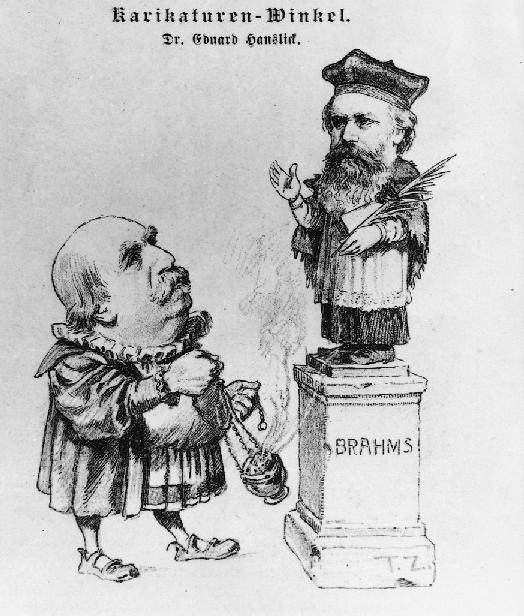
As we approach our next concert, many of our fans are asking, "Why Brahms?" So, what is a period-instrument orchestra that specializes in Baroque and Early-Classical music doing playing the works of Johannes Brahms? Well, our Music Director Nic will tell you why in the coming weeks with a five-part blog post. For now, enjoy this caricature of the composer that could not be any less accurate:


March 11, 2010

Size matters: About the length of natural horns

Recently, we've been asked more than once about our natural horns. So we have asked David Wilson to answer the below. (He adds the caveat: "I will answer the question as best I can, but I'm a violinist, not a brass player"):

My wife and I greatly enjoyed the early French-Handel-Telemann concert last night. We were intrigued by the two-foot-long trumpets and the extra curly horns. I opined that maybe the extra pipe functioned much as today's brass mutes do, softening the sound and helping it to combine with other instruments. (But I'm willing to be proven wrong.) Your explication, please?


Ensembles like Philharmonia Baroque, which play early music on period instruments (i.e. instruments like the ones used in the period in question, the 17th and 18th centuries in our case), use trumpets and horns without valves. For these "natural" instruments, the length of the instrument (that is, the length of brass tubing) determines the fundamental pitch of the instrument and, by adjusting the tension of the lips, the player can produce the notes in the harmonic overtone series of that fundamental pitch.

For example, if a horn is tuned in D, that means it's a long tube of brass coiled up that's the right length to sound with the note D at a given pitch (like A-415). It's the same principle on which organ pipes are made – the pitch is determined by the length of the pipe. So if a horn is in D, it can play the notes in the harmonic series of D: D, A, D, F-sharp, A, C, D, E, F-sharp, G-sharp, A--that's probably about it. Those notes are great if you're playing in a key that uses those notes, but, if you're playing in a key that uses other notes, you need to start with a length of tube that produces a fundamental note whose harmonic series that contains the notes you need.

One way of having a different length of tube (that is, a different length of horn) is to keep lots of differently-sized horns around, which is expensive and inefficient. What players do is use interchangable "crooks" or removable inner sections on the horn. If you need a horn in C, for example, you need a longer tube than you would for a horn in D (since C is a whole-step lower), so you put in a crook that's exactly that much longer, and voila! your horn is in C. The notes of the C harmonic series are now available to you. You can even change keys by changing crooks in the middle of a piece (as long as the composer writes enough rests for you to remove one crook and put in another).

In the 19th century, instrument makers started experimenting with keys and valves which would allow the player to have an instrument that was the maximum length he would ever need, but would allow him to artificially shorten the length of tubing by diverting the airflow by means of opening or closing valves.
Bernard D. Sherman writes in the recent article in Early Music America Magazine:
Inventors first applied valves to the horn in 1814, yet the results still sounded “intolerable” in the 1820s to the foremost composer for the instrument, Carl Maria von Weber. In the 1830s, when Brahms was born, a Viennese inventor patented an essentially modern valve, and the Parisian composer Jacques Halévy published the first orchestral parts conceived purely for valved horns. They were to be played alongside the old and tellingly named natural horns. Such hybrid scoring continued in the 1840s, with examples from Robert Schumann and Richard Wagner.
So the curlicues of tubing you saw on Philharmonia's brass instruments aren't intended to mellow the sound. You're right, in the sense, that the older, non-valved horns had a more pleasant and mellow sound than their valved descendants – that's why there was so much resistance to valves by some players and composers in the 19th century. Brahms is a prime example of a composer who much preferred the sound of natural brass to valved brass.

February 9, 2010

Announcing 2010-11 – Our 30th Anniversary Season

Today, we announced our 30th Anniversary Season!

Current subscribers can renew their subscriptions now! General public subscriptions go on sale March 15th! Single tickets go on sale August 5th. Keep checking our website, more information will be up in the coming weeks. If you can't wait... you can always join us this weekend for Brahms (just in time for Valentine's)!


Philharmonia Baroque Orchestra and Chorale's
2010-11 Season
* – Philharmonia Baroque premiere
† – Philharmonia Baroque debut

September – Robert Levin plays Mozart
Friday 24 September Herbst Theatre, San Francisco
Saturday 25 September First Congregational Church, Berkeley
Sunday 26 September First Congregational Church, Berkeley
Tuesday 28 September Menlo-Atherton Performing Arts Center, Atherton
Wednesday 29 September Lesher Center for the Arts, Walnut Creek

Nicholas McGegan, conductor
Robert Levin, fortepiano (below)

MOZART
Incidental Music from Thamos, King of Egypt *
Concerto for Fortepiano No. 20 in D minor, K. 466 *
Fragments of newly found works for Fortepiano and Orchestra (U.S. Premiere)
Symphony No. 41 in C major, KV 551 “Jupiter” (Last performed by Philharmonia Baroque on March 2001)


October – Bach’s Wedding Cantata
Friday 15 October Herbst Theatre, San Francisco
Saturday 16 October First Congregational Church, Berkeley
Sunday 17 October First Congregational Church, Berkeley
Tuesday 19 October Menlo-Atherton Performing Arts Center, Atherton

Lars Ulrik Mortensen, conductor and harpsichord (below) †
Maria Keohane, soprano †

BACH
Orchestral Suite No. 1 in C major, BWV 1066
Concerto for Harpsichord in D minor, BWV 1052
Weichet nur, betrübte Schatten,” Wedding Cantata, BWV 202 (February 1982 – Philharmonia Baroque’s first public concert)
Concerto for Harpsichord in D major, BWV 1054


November – Vivaldi’s Four Seasons
Friday 5 November Herbst Theatre, San Francisco
Saturday 6 November First Congregational Church, Berkeley
Sunday 7 November First Congregational Church, Berkeley
Tuesday 9 November Menlo-Atherton Performing Arts Center, Atherton
Wednesday 10 November Lesher Center for the Arts, Walnut Creek

Nicholas McGegan, conductor
Elizabeth Blumenstock, violin (concertmaster)

VIVALDI The Four Seasons, Op. 8, Nos. 1-4 (March 1991)
CORELLI Concerto Grosso Op. 6, No. 11 in B-flat major
PERGOLESI Sinfonia in F major *
DURANTE Concerto No. 5 in A major *
ZAVATERI Concerto decimo a Pastorale, Op. 1 *


December – Handel’s Messiah
Friday 3 December Herbst Theatre, San Francisco
Saturday 4 December First Congregational Church, Berkeley
Sunday 5 December First Congregational Church, Berkeley
Tuesday 7 December Menlo-Atherton Performing Arts Center, Atherton

Nicholas McGegan, conductor
Daniel Taylor, countertenor
John McVeigh, tenor
Tyler Duncan, bass †
Philharmonia Chorale, Bruce Lamott, director
TBA soprano

HANDEL Messiah (December 2002)


January – David Daniels
Saturday 15 January First Congregational Church, Berkeley
Sunday 16 January First Congregational Church, Berkeley
Tuesday 18 January Menlo-Atherton Performing Arts Center, Atherton
Friday 21 January Herbst Theatre, San Francisco

Nicholas McGegan, conductor
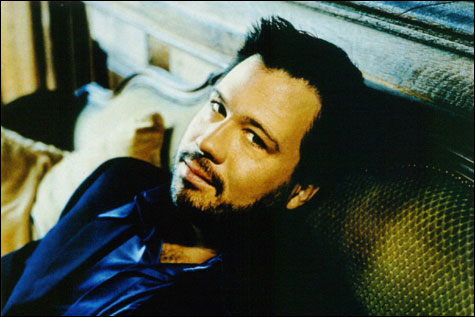
David Daniels, countertenor (below)

VIVALDI Stabat mater, RV 621 *
HANDEL Arias from Giulio Cesare
TELEMANN Suite in F major, TWV 55:F11 “Alster Overture” *


February – Hummel’s Concerto for Keyed Trumpet
Friday 11 February Herbst Theatre, San Francisco
Saturday 12 February First Congregational Church, Berkeley
Sunday 13 February First Congregational Church, Berkeley
Tuesday 15 February Menlo-Atherton Performing Arts Center, Atherton

Nicholas McGegan, conductor
Gabriele Cassone, keyed trumpet (below)†

SPOHR Symphony No. 2 in D minor, Op. 49 *
HUMMEL Concerto for Keyed Trumpet in E major *
MENDELSSOHN Symphony No. 1 in C minor, Op. 11 *


March – Flicka!
Friday 4 March Herbst Theatre, San Francisco
Saturday 5 March First Congregational Church, Berkeley
Sunday 6 March First Congregational Church, Berkeley
Tuesday 8 March Menlo-Atherton Performing Arts Center, Atherton
Wednesday 9 March Lesher Center for the Arts, Walnut Creek

Nicholas McGegan, conductor
Frederica von Stade, mezzo-soprano (below)†

REBEL Les Caractères de la danse *
Nathaniel STOOKEY Into the Bright Lights (poetry by Flicka) (U.S. Premiere)
RAMEAU Les Indes galantes suite d’orchestre
GLUCK Arias


April – Haydn’s Creation
Friday 8 April Herbst Theatre, San Francisco
Saturday 9 April First Congregational Church, Berkeley
Sunday 10 April First Congregational Church, Berkeley
Tuesday 12 April Menlo-Atherton Performing Arts Center, Atherton
Wednesday 13 April Lesher Center for the Arts, Walnut Creek

Nicholas McGegan, conductor
Dominique Labelle, soprano
Thomas Cooley, tenor
Philharmonia Chorale, Bruce Lamott, director

HAYDN The Creation (April 1994)


Celebrating 30 Years of Inspired Sound
When Philharmonia Baroque Orchestra of the West played the first notes of Johann Sebastian Bach’s Wedding Cantata at Herbst Theatre on February 4, 1982, no one guessed what the future would hold. At the time, just having formed the first period instrument ensemble on the West Coast was a feat in itself. By the mid-1970s, a small community of musicians and craftsmen had converged on the Bay Area, all inspired by a countercultural phenomenon: the early music movement. It was not until a fateful moment in 1977 that the true power of this rediscovered period of music was realized at a summer camp on the Russian River—a roomful of these musicians played together as an ensemble, on period instruments, for the very first time. They produced a sound so full of life, expression, exuberance, clarity and subtlety that it seemed to vibrate from the hearts and minds of the composers.

The moment was so moving, so unique, that one musician—Laurette Goldberg—became obsessed with creating an orchestra that would be able to recreate the richness, brilliance, flexibility and articulation that the composers of the Baroque and early Classical periods intended. Laurette spent five years bringing together a group of people who would support the musicians who became Philharmonia Baroque. At thetime, her ideas were radical—a chamber orchestra, Baroque and early-Classical repertoire, period instruments, but her desire was not—to create something meaningful, affecting, transcendent.

Since the very beginning, Philharmonia Baroque has been about the love of a sound—a sound, once heard, that changes once and for all the way we want to experience music, whether on stage or in the audience. This inspiration has guided Philharmonia Baroque from the start, and the organization’s ultimate goal has remained constant since its inception 30 years ago: we want our music to delight, to inspire and to educate—to increase the level of beauty, sensitivity and joy in a complex world.

We hope to see you this season and next!