Check them out:
We've been Fall Arts Previewed!
September Program Notes
Videos: Levin on Mozart
What I did on my summer vacation, pt. 1
Thank you for following this blog. Please keep up with us on facebook and our new website.
Showing posts with label Composers. Show all posts
Showing posts with label Composers. Show all posts
August 27, 2010


June 25, 2010
Soccer: Baroque? Classical? Romantic?
Do you have soccer (ahem... football) fever like many of us in the office? Maybe you can answer this bit of trivia:

Which piece of orchestral or operatic music was published the year that the first official rules of soccer were agreed upon and first "Football Association" was founded in a tavern in London?
A: John Blow's Venus and Adonis (1683)
B: Joseph Haydn's Symphonies No. 12 and 13 (1763)
C: Hector Berlioz's Les Troyens (1863)
And now, in anticipation of tomorrow's elimination round game:

UPDATED 6/28: We guess we'll have to hang onto that memory. Good effort, USA!
May 25, 2010
Closing out 20 years: Nic and the Göttingen International Handel Festival
 Today, our Music Director Nic (left) conducted the final performance of the Göttingen International Handel Festival – the dark opera Tamerlano (HWV 18). Nic has led the Festival as its Music Director for the last 20 years. In 1991, he was passed the baton (figuratively of course, Nic doesn't use a baton as you may remember) by Sir John Eliot Gardiner. Next year, Nic will pass the honors of leading the Festival to (fittingly) yet another British conductor – Laurence Cummings. This year was the Festival's 90th year – to learn more about the festival, watch this video.
In related news, SFCV gave the Festival's new recording of Mendelssohn's arrangement of Handel's Dettinger Te Deum (left) a rave review today! This disc features Nic conducting many of Philharmonia Baroque's musicians in the FestspielOrchester Göttingen, as well as frequent collaborators Dominique Labelle and William Berger and recent guests Thomas Cooley (.pdf) and Colin Ainsworth (.pdf).
April 28, 2010
An influential afterlife: Exploring Orlando Furioso Part 3
Michael Wyatt joins us for the final post on Orlando furioso (read Parts 1 & 2):


A mere summary does little justice to the dazzling linguistic and conceptual texture of Ariosto’s great poem, elaborated in almost 40,000 lines through a complex network of narrative threads and a cast of thousands.
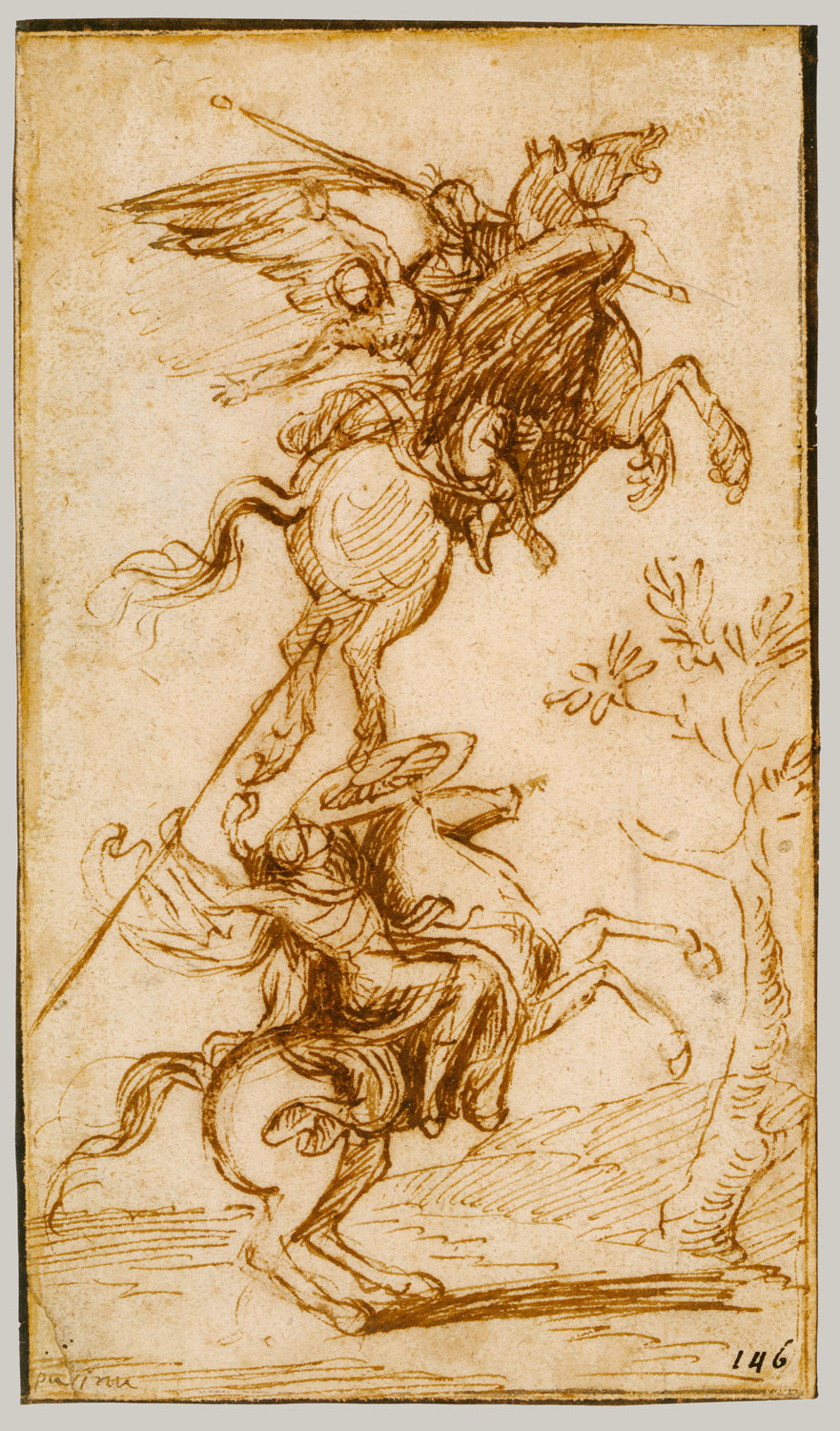
"The Sorcerer Altante Abducting Pinabello's Lady" by Nicolas Poussin (French, 1594–1665)
Orlando furioso was one of the run-away publishing successes of the early modern period. The poem appeared in almost fifty separate editions in Italian in the sixteenth and seventeenth centuries (many of them reprinted many times over), but the Furioso has exercised an equally strong attraction translated into foreign languages. By the early twentieth century, there had been almost ninety versions – partial and complete – in French, twenty-nine in Spanish (it is one of the few books Don Quixote saves from his bonfire of the vanities), some twenty in Russian, thirty in German and eighteen in English. There have been translations of Orlando furioso into Czech, Latin, Hungarian, Portuguese, Dutch, Polish and Hebrew; the first Asian translation seems to be the one published in Japanese in 2002.

En Espanol!
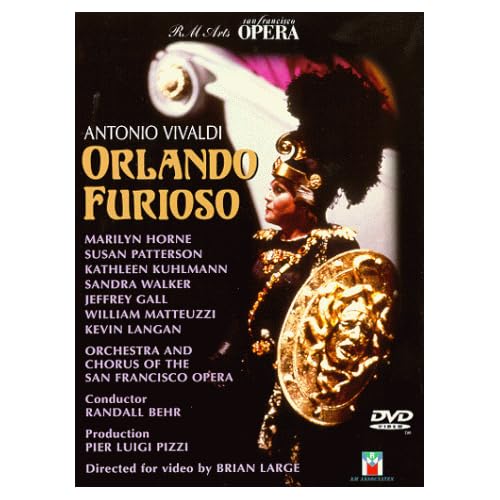
Ariosto’s poem has had an equally rich history of re-elaboration in other forms, giving rise to a veritable industry of literary imitations and responses, visual representations and adaptations for the theater, film, television and radio. Handel wrote three operas to libretti based on the Furioso – Alcina, Ariodante, and Orlando – and composers as varied as Francesca Caccini, Lully, Porpora, Vivaldi, Rameau, and Haydn have found in Ariosto a deep vein of inspiration. Ariosto’s enduring fascination is evident today in the chivalric repertory of the Sicilian puppet theater, the opera dei pupi, a tradition that emerged on the island in the early nineteenth century and continues to be practiced today by several companies in Catania and Palermo.
March 19, 2010
Into the crazy world of Orlando: From our Handel expert (and Music Director) Nic McGegan
Nicholas McGegan joins us again to let us know what's so special about George Frideric Handel's opera Orlando, which the orchestra and chorale will perform in April:

Pictured above is the autographed score of Orlando, one of a series of so-called magic operas by Handel. While the sources of many of his plots are derived from classical history or mythology, the 1733 opera Orlando (as well as Ariodante and Alcina, both of 1735) is based on an Italian epic poem from the Renaissance – Orlando furioso by Ludovico Ariosto. Its story is one of extravagant valour and passion taken to the point of madness. Indeed, one could say that works in this genre were parodied by Cervantes in Don Quixote.

Extravagance, passion and madness are, of course, the life blood of opera and it is clear that Handel was inspired by the subject to produce one of his finest works. This is the last opera he wrote for the great alto castrato Senesino (left) for whom he had composed operas for a dozen years. Senesino was a difficult character but a superb singer and, unlike Farinelli, a splendid actor. This must have been a perfect role for him. The Mad Scene that forms the climax to the Second Act is one of the moments of Baroque Opera. Gone are all the normal conventions of the genre, even normal rhythms go awry as Orlando descends (in his own deluded mind) into Hell in five/eight time.
Into this crazy world, Handel, or rather his librettist, introduces two characters who are not found in Ariosto’s original. One is the magus Zoroastro who watches over the mad Orlando and eventually cures him of his insane love for Angelica. He is a wise father figure who will reappear in the Magic Flute as Sarastro. The other is the shepherdess Dorinda who represents an ordinary ‘down to earth girl’ mixed up in the rarified world of chivalrous romance. Her reactions are sometimes comic but she is also emotionally hurt by the crazy grandees about her, who use her and occasionally abuse her. However, she is the contact between us, the audience, and the other characters. This role was created for Celeste Gismondi, a Neapolitan comedienne, newly arrived in London. Obviously, she was an excellent singer and pert actress. It is with her character that we most often sympathise.
Handel’s music is of the highest level throughout and, because of the story, he was inspired to experiment with glorious results. Apart from the famous Mad Scene, the Trio at the end of the First Act is one of the finest ensembles he ever wrote and the aria during which Orlando finally collapses would not be out of place in a Bach Passion.
.jpg) All this emotional extravagance was matched on stage by new scenery and costumes (like pictured left) specially made for the production. This was unusual at the time and was even noted in the newspapers. In addition, there were flying machines, including a chariot drawn by dragons to take Orlando out of Hell. We are, of course, giving the work in concert, so the audience will have to imagine the magic world on stage that went hand in hand with Handel’s glorious music.
All this emotional extravagance was matched on stage by new scenery and costumes (like pictured left) specially made for the production. This was unusual at the time and was even noted in the newspapers. In addition, there were flying machines, including a chariot drawn by dragons to take Orlando out of Hell. We are, of course, giving the work in concert, so the audience will have to imagine the magic world on stage that went hand in hand with Handel’s glorious music. February 10, 2010
Nic on performing Brahms: Pt. 5
Nic is back for his final post! Want to learn more about performing Brahms on period instruments? Listen to our audio preview, featuring Nic, string player Maria Caswell and host Teddy Wing. Now, here is Nic on orchestra arrangement – you may be surprised to see where your favorite musicians are sitting at our upcoming concerts:
 Orchestra size and arrangement –
 In Brahms’ time, as in earlier periods, the size of orchestras varied widely. Brahms himself seems to have preferred intimate halls with relatively small forces. The Meiningen orchestra had 48 members and the orchestra in Karlsruhe, which gave the first performance of the 1st Symphony, had 49 members. The string count was 9 first violins, 9 second violins, 4 violas, 4 cellos, and 4 basses.
Many German orchestras continued to perform concerts standing. In 1893, one of the members of the Leipzig Gewandhaus Orchestra was quoted as saying: “In the Gewandhaus we are wholly different people than in the theatre; in a black dress coat and standing erect at the desk…a different higher spirit dominates us.” The Meiningen orchestra under von Bülow (with the young Richard Strauss as his assistant) also played standing. The orchestra will probably sit, since we’ll be playing a substantial concerto, but it might be interesting to try it out.
Georg Henschel, when he took charge of the newly founded Boston Symphony in 1881, sent Brahms a couple of seating plans for his approval. Here is the one the composer favoured, the one the orchestra will be giving a try:

Thank you for reading, I hope that you will enjoy our concerts. For further reading, I recommend the following books:
- Brown, Clive. 1999. Classical and Romantic Performance Practice 1750-1900. Oxford University Press.
- Haynes, Bruce. 2002. A History of Performing Pitch (The Story of “A”). Scarecrow Press.
- Lawson, Colin, and Robin Stowell. 1999. The Historical Performance of Music, an Introduction. Cambridge University Press.
- Musgrave, Michael, and Bernard D. Sherman. 2003. Performing Brahms. Cambridge University Press.
February 8, 2010
Nic on performing Brahms: Pt. 4
Nic continues his post about the style that the orchestra will perform Brahms in this week:

Brahms was notoriously metronome-averse, so neither of the pieces that we will be playing are provided with metronome markings. Joachim, however, had no such qualms, and his edition of the Violin Concerto (1910) does have them. In the German edition of Joachim’s Violinschule (1905), which contains the violin part of the concerto, there are faster markings than in the 1910 edition; those are given here in parenthesis. They are:
Mvt. 1. Quarter note =120 (126).
Mvt. 2 Eighth note = 72
Mvt. 3 Quarter note = 96 (104). Poco più presto, Quarter note = 120 (132)
These however are not to be thought of as tempi that apply to a complete movement. There is plenty of evidence to show that Brahms, like many of his time, preferred a very flexible approach to speed. The orchestra will try this, at least in the Serenade. There is a wide variation in the overall timings of some Brahms’ Symphonies from one performance to another. For example, Symphony No. 1 was performed in 37 minutes by Hans von Bülow and the Meiningen Orchestra in 1884, compared to Carlo Maria Giulini and the L.A. Philharmonic in 1981 at slightly over 49 minutes.
Pitch –
We will be tuning to A-440. When touring, Richard Mühlfeld would send a tuning fork ahead to the next venue so that the piano could be tuned to the right pitch. His fork was at A-440. This was, however, by no means the universal pitch at the time. ‘Pitch battles’ were fought all over Europe between instrumentalists, who favoured a higher pitch, and opera companies, whose singers tried to keep the pitch lower. Often such a war would go on within the same city as in London. Pitch could vary from somewhere in the 420’s to the mid 450’s. So 440 seems a reasonable compromise!
Phrasing –

Stay tuned, Nic's final post will be about the most radical change for the orchestra this set: orchestra size and arrangement.
February 3, 2010
Nic on performing Brahms: Pt. 3
Vibrato –
We have the evidence of Joachim’s recordings that he perhaps used relatively little vibrato (the oscillation of pitch which instruments can produce to imitate the sound of human singing – learn more about wrist vibrato and arm vibrato). However, Fanny Davies, who heard him play the Third Piano Trio in 1887, noted that in one passage at least (marked espressivo) he used vibrato to great effect. On the other hand, as early as 1863, cellist David Popper was both praised and lampooned for his continuous vibrato. He played frequently with Brahms after 1886. Mühlfled also used vibrato on the clarinet. However, it is important to remember that these players were soloists and that orchestral players used much less, if any, vibrato. Indeed, the Vienna Philharmonic preserved an almost vibrato-less style until the Second World War. The orchestra will try to copy this with the exception of notes marked <>.
Portamento –
Already in 1811, composer Antonio Salieri complained of Viennese orchestral string players using portamenti (sliding from one pitch to another). One can hear in Joachim’s recordings that he employed portamento as a soloist. His own editions and his treatise on violin playing (Violinschule) contain many examples of this practice. Of special interest for our concert is his edition of the Brahms Violin Concerto, in which he provided fingerings throughout and indicated plenty of portamenti. Early orchestral recordings offer clear evidence of the widespread use of this embellishment. Be prepared for lots of them in our concert!
 Flute treatises for the pre-Boehm flute have fingering charts for portamenti. The increasing amount of keywork on later instruments made it harder to glide from note to note, but John Clinton’s Flute Treatise (A Code of Instructions for the Fingering of the Equisonant Flute by the Inventor and Patentee, 1860) shows that the practice did continue into the second half of the 19th century. As he wrote himself: "This ornament is effected by gradually drawing or sliding the fingers off the holes, instead of raising them in the usual manner; by this means is obtained all the shades of sound between the notes, so that the performer may pass from one note to another, as it were, imperceptibly; it produces a pleasing effect, when sparingly used. It is denoted by the mark [shown above the notes above]. The fingers must be drawn off the holes in a line towards the palm of the hand; the employment of the crescendo with the glide heightens the effect."
Bowing –
Studies of the old orchestral material used by the Berlin and Vienna Philharmonics show that more notes were played in one bow stroke than now. This means that the overall volume must have been less. The orchestra will try this. British audiences in the early part of the 20th century were astonished by the unanimity of bowing when they heard the Berlin and Vienna Philharmonic Orchestras for the first time.
January 28, 2010
Nic on performing Brahms: Pt. 2
We don't know if you saw it, but Jonathan Rhodes Lee wrote a great preview of February's concert on San Francisco Classical Voice. In the article, he posed the question: "Will we hear the concerto as Joachim played it? As Brahms would have wanted it heard? As we want him to have wanted it heard? Or as we want it heard following our own standards?" Well, here is Nic's second post to answer that very question:


Here are a few thoughts on the instruments the orchestra will be playing in February:
Strings –
By Brahms’ time the violin, viola and cello had an essentially modern set up, with an angled-back neck and correspondingly higher bridge.
On the violin, gut D, A and E strings were the norm at least until about 1920. A silver or copper-wound G string was usual. Louis Spohr claimed to have invented the chin rest around 1820 to make large shifts in the position of the left hand easier; Spohr’s centrally placed chin rest was widely but by no means universally used. By 1850, the chin rest had migrated to its present position to the left of the tailpiece.
For cellists, the spike or endpin came into use in the 1860’s but many players, including Alfredo Piatti, the cellist of Joseph Joachim’s “London” quartet preferred not to use one.
Double basses usually had four strings, though Domenico Dragonetti, Beethoven’s favourite bassist, used only three. Hans von Bülow was one of the first to use a five string basses in the orchestra at Meiningen (a town in central Germany; Wagner and Brahms were both associated with this orchestra), but he did so some years after Brahms had written his Second Symphony of 1877, where in Bar 13 of the opening movement he writes a rest rather than a low D#; most basses could not yet play that note.

Dragonetti, Robert Linley and John Loder. Edinburgh before 1846.
Winds and brass –
The cylindrical bore flute with the Boehm key system was introduced in 1847, but was slow to gain acceptance. Brahms’ favourite flautist, Franz Doppler, did not play one in the Vienna Philharmonic. Indeed they were banned from certain orchestras until 1914.
Brahms considered that the level of clarinet playing had generally gone down during his lifetime with the notable exception of Richard Mühlfeld of the Meiningen Orchestra. He played Baermann system instruments made of boxwood.
Mühlfeld's clarinets
Brahms wrote his Trio for horn, violin and piano (Opus 40) for the old Waldhorn (a valveless natural horn) but he would have been hard pressed to find one in an orchestra. The Vienna Philharmonic used the Pumpenhorn (a Viennese horn with three valves), which came in after about 1850.
January 25, 2010
Nic on performing Brahms: Part 1
We are excited to post Music Director Nic McGegan's first blog entry for A415 today! This is the first of a series of posts about our February concerts.

The performance of later Romantic music on period instruments is becoming relatively commonplace in Europe, but, here in the U.S.A., it is much more of a rara avis, at least in the concert hall. I thought that it might be fun for me, as a kind of New Year’s resolution, to jot down some thoughts about how the orchestra might approach the performance of Brahms on period instruments.
Historically-informed performance consists of two basic elements: using period instruments and playing them in what we, perhaps fondly, hope is an appropriate style. For the performance of music before about 1830, both elements have to be combined. After that watershed date, the instruments start to resemble modern ones, but the style of performance differed in many important ways to what one might hear at a modern symphony concert. Our sources on the performance of earlier music are treatises, descriptions and pictures. For music from Brahms onwards, a new source comes into play, namely sound recordings. There is even one of Brahms himself, though, apart from his spoken introduction in a remarkably high, almost squeaky voice, it is impossible to hear much through the miasma of scratches.
For Brahms’ music, we are lucky to have five recordings by his friend, violinist Joseph Joachim, from 1903, plus recorded performances by players and conductors who knew or studied with him. Anyone who wants to delve into this more deeply can read an excellent book called Performing Brahms, edited by Michael Musgrave and Bernard Sherman. There is even a CD with the book with all the Joachim recordings, the one of Brahms himself, piano students of his and Clara Schumann and much more besides.
Stay tuned for more posts in the coming weeks...
January 22, 2010
Meet Mr. Brahms
In yesterday's post, we said that we going to address why Philharmonia Baroque is expanding it's repertoire to play works from 1858 and 1878, some of the newest music we've ever played, but not quite. First, however, let's talk about the beloved Romantic composer of these works: Johannes Brahms. Violinist and Philharmonia Baroque staffer David Wilson joins us again:

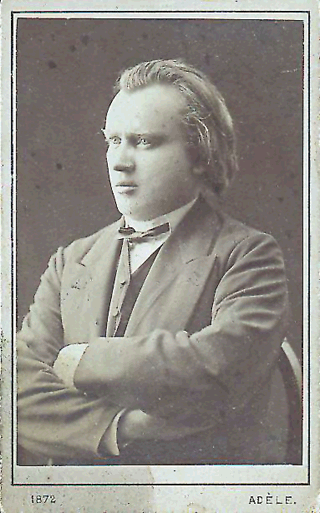
When Johannes Brahms (pictured left) was born in 1833, his native city of Hamburg already had a musical tradition that was centuries old. Opera, church music and music publishing all thrived throughout the 17th and 18th centuries. The city also had a tradition of public concerts – something we take for granted today but was not a given throughout history. This was the environment into which Brahms was born. His family was working class, but valued music and education. Brahms went to school and had lessons on piano, cello and horn. As a teenager, he began to perform in public as a pianist and to write music.
At the age of 20, Brahms was meeting and playing music with many musicians who were or would become some of the foremost performers and composers of their time, including violinist Joseph Joachim, for whom Brahms would later write his only violin concerto, and Franz Liszt. Joachim told Brahms that he really should get to know the Schumanns, Robert and Clara, both of whom were composers. He did so in September of 1853 and a lifelong friendship between the three musicians began. Brahms spent the next ten years performing, composing chamber music and thinking about the creative process and how that relates to life.
In 1855, frustrated with composition to the point of writing that he no longer had any idea how one goes about composing music, he turned to early music – the counterpoint of Bach, for example, and to baroque and renaissance dance forms – as well as folk music for creative inspiration. It worked. (In our time, Estonian composer Arvo Pärt reached a similar creative impasse and, like Brahms, he resolved it through a study and application of the principles of early music.) Brahms’s interest in early music was also reflected in the repertoire he chose for the choirs and orchestras he conducted in Hamburg and Vienna, as well as the repertoire he performed in his piano recitals. In 1850, the Bach-Gesellschaft (Bach Society) was formed in Germany to publish the complete works of J.S. Bach. Brahms owned a number of volumes (cantatas) of that complete-works edition and may even have been a subscriber of the Society.
In 1869, the first full performance of his German Requiem was greeted so enthusiastically that Brahms finally became known as an important composer throughout Europe. Despite a disastrous stock market collapse in 1873 that trashed the economies of most European countries (and that of the U.S.), Brahms’s own fortunes soared in the 1870s in the form of concert tours, guest conducting engagements throughout Europe, awards and knighthoods, publishing contracts and teaching engagements. He continued to compose in many genres, including large works involving orchestra.
Brahms died of liver cancer on April 3, 1897. Although he was romantically linked to a number of women during his lifetime, he never married.
January 21, 2010
Why Brahms?
As we approach our next concert, many of our fans are asking, "Why Brahms?" So, what is a period-instrument orchestra that specializes in Baroque and Early-Classical music doing playing the works of Johannes Brahms? Well, our Music Director Nic will tell you why in the coming weeks with a five-part blog post. For now, enjoy this caricature of the composer that could not be any less accurate:
December 4, 2009
Composer Warbucks: Vivaldi and the Ospedale della Pietà
Pio Ospedale della Pietà? Again and again the name of this Italian girls' orphanage and school comes up when reading about the composer Antonio Vivaldi, why? The obvious reason is because Vivaldi worked there for over two decades! Another reason is because the Piéta had one of the finest orchestras in Europe and Vivaldi wrote much of his music for the orphans. David Wilson tells us more:

The Pio Ospedale della Pietà in Venice (image below), usually described as an orphanage and music school, was extremely important in Antonio Vivaldi’s life. At the age of 25, Vivaldi was hired by the Pietà as a violin teacher. It was his first “real” job, and his association with the Pietà continued in one form or another for the rest of his life. A great deal of Vivaldi’s music was written for concerts and religious services at the Pietà.

In 1198, Pope Innocent III decreed that homes should be established which would care for orphans and children who had been abandoned. These homes were generally associated with churches and convents. By means of a “baby hatch” or “foundling wheel” (image below), a mother could anonymously deliver a baby, usually a newborn, into the care of the church. The mother would place the baby in a sort of revolving door, rotate the device so that the baby was inside, and then ring a bell to alert those inside that a baby had been delivered. Sometimes babies were abandoned because of a deformity, but more often it was because they had been born out of wedlock.

The Ospedale della Pietà was one of four such homes in the city of Venice. The Pietà took in mostly girls, and by Vivaldi’s time had become well known for the quality of the musical education provided to its residents. The girls of the Pietà became such accomplished musicians that by Vivaldi’s time the institution had developed a reputation as a first-rate music school. In fact, noble families with musically talented daughters would often try to pretend that the girls were orphans in order to enroll them at the Pietà, a practice that was sternly disapproved of by the institution as it was intended to be a charitable organization.
In fact, as Robert Mealy wrote in last season’s program notes for March 2009’s “Winds and Waves” concerts: the young women had to renounce any professional career once they left the institution.
“These terms meant that there were a good number of women who stayed on in the Pietà, becoming teachers. This all-woman orchestra was enough of a novelty (and their playing was of such exceptional ability) that their performances became one of the attractions of Venice, a standard stop on the Grand Tour of young, well-to-do gentlemen, who delighted in the mystery of hearing these women play behind a “grille” or screen.”
November 30, 2009
The Red Priest
With December nearly upon us, Philharmonia Baroque Orchestra and Chorale are already rehearsing for their next concert: "Gloria! A Holiday Celebration." This concert features primarily sacred works and pastorales by Italian Baroque masters, focusing on one of our favorite Baroque violinists: Antonio Vivaldi. Violinist and Philharmonia Baroque staffer David Wilson is back to fill us in about the composer who did more than just make music for the church: 
When Antonio Vivaldi was born in 1678, his father Giovanni was a professional violinist employed by the Basilica of San Marco in Venice. Antonio no doubt studied violin with his father and, by time he was a teenager, he was occasionally subbing for his father at San Marco and being hired at the basilica as an extra player for special occasions.
Despite this background in music, Vivaldi’s life seemed to be aimed at the priesthood. He was known during his life as “The Red Priest,” a reference to his red hair. He studied for the priesthood at several churches in Venice beginning when he was 15 years old and was ordained at the age of 25. However, within a few years of his ordination, he permanently stopped celebrating Mass, but still retained his status as a priest (and presumably retained other priestly functions, such as hearing confessions).

Famous 1723 caricature of "Il prete rosso" by Pier Leone Ghezzi.
The reasons for this change are unclear. Vivaldi is known to have suffered all his life from bronchial asthma, which could possibly have interfered with his ability to speak and chant for the duration of a Mass. There is a story, almost certainly spurious, that Vivaldi once left the altar in the middle of Mass to return to the sacristy. In the story, the reason was that a clever fugue subject had just occurred to him and he wanted to write it down before he forgot it. If the story is true, it could also be that he had an asthma attack during Mass and needed to sit down. It is also known that some years later, Vivaldi was censured for conduct unbecoming a priest. Although the reason for Vivaldi’s censure is unclear, it is also possible that the reason was also related to his decision to stop celebrating Mass.
Despite the fact that Vivaldi did not celebrate Mass and despite any difficulties with the church hierarchy, he was known during his life as a pious man and frequently wrote an abbreviation of the religious motto “Laus Deo Beataeque Mariae Deiparae Amen” on his manuscripts.Editor's Note: We think that might mean "Praise God, the blessed Mary, and the Son of God. Amen." However, we're not sure. Do you know? Most of us are a bit rusty with our Latin (if we ever took it in the first place).
November 5, 2009
A masque? Let's ask...
As you read our program notes and listen to our audio concert preview for November’s all-Purcell program that features the composer's Dido and Aeneas, have you been wondering what an “all-sung masque” is? Well, a few of us in the office were wondering that very same thing, so we did a little research to find out just what a masque is…

A turn of the century masque in the home of Sir Henry Unton, 1596
A masque was an elaborate private entertainment that grew in popularity in England during the 16th and 17th century until it became, arguably, one of the highest art forms in England. Many of the greatest writers, poets, songwriters, artists, architects and humanists of the time collaborated on these costumed spectacles of dance, vocal and instrumental music and speeches or theatrical scenes. The expense and extravagance of the English masque typically required a wealthy patron and were usually a courtly affair. Not surprisingly, Henry VIII, the accomplished musician, author and poet king oft remembered for his various indulgences, sponsored the first masque or ‘disguising’ in 1512.

Oft copied for English masques, Italian dance costumes by Bernardo Buontalenti, 1589

Architect Inigo Jones transformed the Stuart court with his stage design for Florimène, 1635
The masque began simply as a themed evening of social dancing. As it evolved during the reigns of Elizabeth I and Charles I, it began to resemble its origins more and more: the folk tradition (most memorably represented by the play-within-a-play “Pyramus and Thisbe” in Shakespeare’s A Midsummer Night’s Dream) of a masked troupe of players who would visit a court to offer gifts and entertainment around holidays and personal or state events worthy of celebration. Masques eventually grew more rigid in their structure: five short acts of a play performed by professional actors (usually a Classical allegory flattering to the patron) with interludes of formal dances or “entries.” The dances were truly what was important: some choreographed for practiced masked courtiers (“masquers”), others for unmasked professional dancers (these entries were called “antimasques”) and at least one “revel” or social dance for members of the audience.

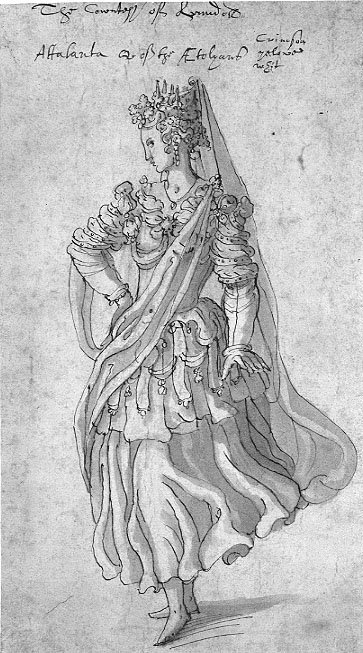

Three masque costumes by Inigo Jones
The music of masques was clearly important, but little is known about these pieces because almost no complete scores have survived. This is why so few masques are reconstructed for modern audiences (and probably why so many of us are asking: what’s a masque?). It is suspected that violin bands accompanied the main dances and sometimes woodwind bands the professional dancers. Probably while accompanying themselves on lutes, an ensemble of royal singers would introduce or comment on the dances through songs, many of which were popular beyond the walls of the court.
So how is all of this related to the all-sung masques or “first English operas” of Baroque composers John Blow and Henry Purcell? Well, ahem, as you’ve no doubt read in our program notes, the English Civil War (sometimes called the Puritan Revolution) and the resulting first Commonwealth of England in the mid-17th century led to the closing of theatres, the banishment of secular music and even the destruction of church organs. The masque became so inextricably linked to Charles I’s absolutism and excessive lavishness that he was beheaded in front of the Banqueting House where most masques were held.

A German print of the ghastly end to the reign of Charles I, 1649
Not surprisingly, after the Restoration of 1660, the masque never returned to the same level of popularity or extravagance as it enjoyed in the early 17th century. As a result, the art form changed, becoming less participatory and thus more reliant on the skills of professional players or highly practiced amateurs. As the social aspect of the entertainment was reduced, so was the importance of the formal dances (sorry, Mark Morris). This allowed the music to come front and center, especially within the context of the pioneering operatic works of Jean-Baptiste Lully, whose success remolding the Italian model meant that the new art form traveled far beyond the court of Louis XIV.
Learn more: Society of Whitehall Masque, Shafe – The Early Stuarts
Subscribe to:
Posts (Atom)


 Posts
Posts


