Hear for yourself:
July 15, 2010
Gonzalo in the Wall Street Journal
Hear for yourself:
April 8, 2010
Meet Goldilocks
March 11, 2010
Size matters: About the length of natural horns
My wife and I greatly enjoyed the early French-Handel-Telemann concert last night. We were intrigued by the two-foot-long trumpets and the extra curly horns. I opined that maybe the extra pipe functioned much as today's brass mutes do, softening the sound and helping it to combine with other instruments. (But I'm willing to be proven wrong.) Your explication, please?
Ensembles like Philharmonia Baroque, which play early music on period instruments (i.e. instruments like the ones used in the period in question, the 17th and 18th centuries in our case), use trumpets and horns without valves. For these "natural" instruments, the length of the instrument (that is, the length of brass tubing) determines the fundamental pitch of the instrument and, by adjusting the tension of the lips, the player can produce the notes in the harmonic overtone series of that fundamental pitch.In the 19th century, instrument makers started experimenting with keys and valves which would allow the player to have an instrument that was the maximum length he would ever need, but would allow him to artificially shorten the length of tubing by diverting the airflow by means of opening or closing valves. Bernard D. Sherman writes in the recent article in Early Music America Magazine:
Inventors first applied valves to the horn in 1814, yet the results still sounded “intolerable” in the 1820s to the foremost composer for the instrument, Carl Maria von Weber. In the 1830s, when Brahms was born, a Viennese inventor patented an essentially modern valve, and the Parisian composer Jacques Halévy published the first orchestral parts conceived purely for valved horns. They were to be played alongside the old and tellingly named natural horns. Such hybrid scoring continued in the 1840s, with examples from Robert Schumann and Richard Wagner.
March 2, 2010
Like the human voice...
February 3, 2010
Nic on performing Brahms: Pt. 3
Flute treatises for the pre-Boehm flute have fingering charts for portamenti. The increasing amount of keywork on later instruments made it harder to glide from note to note, but John Clinton’s Flute Treatise (A Code of Instructions for the Fingering of the Equisonant Flute by the Inventor and Patentee, 1860) shows that the practice did continue into the second half of the 19th century. As he wrote himself: "This ornament is effected by gradually drawing or sliding the fingers off the holes, instead of raising them in the usual manner; by this means is obtained all the shades of sound between the notes, so that the performer may pass from one note to another, as it were, imperceptibly; it produces a pleasing effect, when sparingly used. It is denoted by the mark [shown above the notes above]. The fingers must be drawn off the holes in a line towards the palm of the hand; the employment of the crescendo with the glide heightens the effect."January 28, 2010
Nic on performing Brahms: Pt. 2
Here are a few thoughts on the instruments the orchestra will be playing in February:
Strings –
By Brahms’ time the violin, viola and cello had an essentially modern set up, with an angled-back neck and correspondingly higher bridge.
On the violin, gut D, A and E strings were the norm at least until about 1920. A silver or copper-wound G string was usual. Louis Spohr claimed to have invented the chin rest around 1820 to make large shifts in the position of the left hand easier; Spohr’s centrally placed chin rest was widely but by no means universally used. By 1850, the chin rest had migrated to its present position to the left of the tailpiece.
For cellists, the spike or endpin came into use in the 1860’s but many players, including Alfredo Piatti, the cellist of Joseph Joachim’s “London” quartet preferred not to use one.
Double basses usually had four strings, though Domenico Dragonetti, Beethoven’s favourite bassist, used only three. Hans von Bülow was one of the first to use a five string basses in the orchestra at Meiningen (a town in central Germany; Wagner and Brahms were both associated with this orchestra), but he did so some years after Brahms had written his Second Symphony of 1877, where in Bar 13 of the opening movement he writes a rest rather than a low D#; most basses could not yet play that note.
Dragonetti, Robert Linley and John Loder. Edinburgh before 1846.
Winds and brass –
The cylindrical bore flute with the Boehm key system was introduced in 1847, but was slow to gain acceptance. Brahms’ favourite flautist, Franz Doppler, did not play one in the Vienna Philharmonic. Indeed they were banned from certain orchestras until 1914.
Brahms considered that the level of clarinet playing had generally gone down during his lifetime with the notable exception of Richard Mühlfeld of the Meiningen Orchestra. He played Baermann system instruments made of boxwood.
Brahms wrote his Trio for horn, violin and piano (Opus 40) for the old Waldhorn (a valveless natural horn) but he would have been hard pressed to find one in an orchestra. The Vienna Philharmonic used the Pumpenhorn (a Viennese horn with three valves), which came in after about 1850.
January 25, 2010
Nic on performing Brahms: Part 1
We are excited to post Music Director Nic McGegan's first blog entry for A415 today! This is the first of a series of posts about our February concerts.
As we all know, Philharmonia Baroque is starting the New Year with a voyage into what, for our orchestra, will be uncharted waters: performing the music of Johannes Brahms (pictured left). It promises to be a fascinating and thrilling adventure both for the orchestra and, we hope, for you the listener.
The performance of later Romantic music on period instruments is becoming relatively commonplace in Europe, but, here in the U.S.A., it is much more of a rara avis, at least in the concert hall. I thought that it might be fun for me, as a kind of New Year’s resolution, to jot down some thoughts about how the orchestra might approach the performance of Brahms on period instruments.
Historically-informed performance consists of two basic elements: using period instruments and playing them in what we, perhaps fondly, hope is an appropriate style. For the performance of music before about 1830, both elements have to be combined. After that watershed date, the instruments start to resemble modern ones, but the style of performance differed in many important ways to what one might hear at a modern symphony concert. Our sources on the performance of earlier music are treatises, descriptions and pictures. For music from Brahms onwards, a new source comes into play, namely sound recordings. There is even one of Brahms himself, though, apart from his spoken introduction in a remarkably high, almost squeaky voice, it is impossible to hear much through the miasma of scratches.
For Brahms’ music, we are lucky to have five recordings by his friend, violinist Joseph Joachim, from 1903, plus recorded performances by players and conductors who knew or studied with him. Anyone who wants to delve into this more deeply can read an excellent book called Performing Brahms, edited by Michael Musgrave and Bernard Sherman. There is even a CD with the book with all the Joachim recordings, the one of Brahms himself, piano students of his and Clara Schumann and much more besides.
Stay tuned for more posts in the coming weeks...
January 7, 2010
The Story of "A:" More about Baroque pitch
Baroque oboe legend Bruce Haynes has researched the issue of historical pitches in detail. I suggest reading his book The Story of “A” if this post interests you. Bruce points out that we talk about pitch levels by means of two coordinates, a pitch name and a frequency in hertz, e.g. “A-415.” For about the last century, the standard pitch level has been A-440, meaning that, wherever you go in the world, Western classical music is likely to be played at a pitch level in which the note A in the middle of the treble staff is tuned to 440 hz. (Editors note: a hertz is a unit of frequency – one cycle per second – that measures, in this case, the traveling wave or oscillation of pressure caused by vibrations that we discern as sound). Having a pitch standard is a convenience for musicians, nothing more.
Prior to the late 19th century, however, there were no universally recognized pitch standards. One could travel from one part of Europe or, in some cases, from one city to another and find music being made at different pitches. For a string player, this in no problem – the string can be tuned to any pitch (within reason) – but for a fixed-pitch instrument, like a flute or an oboe, this can be a huge problem. It might mean that if you were an oboist, you could play in tune with a violin band but not with the church organ, or you could form your own band with your friend with a recorder made in your village but not with your friend with a recorder from the next town over.In the Baroque Era, pitch levels as high as A-465 (17th century Venice) and as low as A-392 (18th century France) are known to have existed. A few generalizations can be made:
- pitch was high in North Germany and lower in South Germany
- pitch was low in Rome but high in Venice
- pitch in France depended on whether you were playing chamber music, opera or something else.
One of the pitches used during the baroque period was A-415. Since 415 hz. is about a half-step below the modern standard of A-440, the pitch of A-415 was seized on as a convenient modern “baroque pitch” standard, because in the early days of the historical performance movement a harpsichord would sometimes play with groups at A-440 and sometimes at a lower pitch, and if the difference in pitch is a half-step, the keyboard could be made so that it slides over one string so that the A key played a string tuned to 440 hz. in one position and a string tuned to 415 hz. in the other position.
“So when you play baroque music, you tune to a G-sharp,” some people say at this point. Not so! We tune to an A, but we define the A differently depending on what kind of music we’re going to play. A baroque violinist may carry 4 different tuning forks (or one handy iPhone app), and a baroque flutist probably owns two or three different flutes at different pitches.
December 7, 2009
Learning French... Baroque String Techniques
November 2, 2009
Learn more about our November concerts
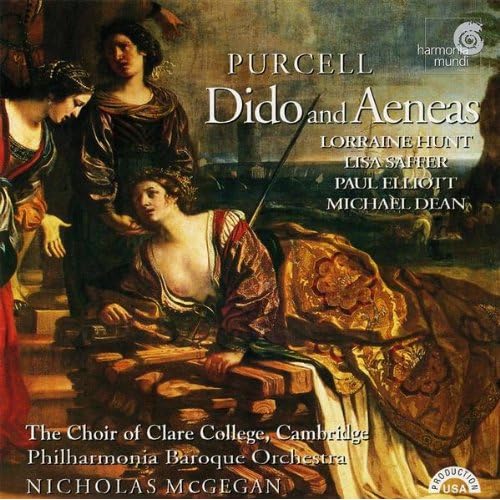
What is, to my mind, the finest Dido and Aeneas recording currently available features an American cast and orchestra. The 1993 Harmonia Mundi recording with the late mezzo-soprano Lorranie Hunt Lieberson in the title role has it all. For sheer gorgeous vocalism wed to dramatic intensity, Lieberson is unsurpassed. Her every phrase and gesture carries weight. Lieberson's singing of the lament? I had to sit in silence afterward and collect myself... This recording, with [Nicholas] McGegan leading a remarkably responsive Philharmonia Baroque Orchestra, cuts to the heart of the work. The Dido and Aeneas (sung by baritone Michael Dean) exchange in Act III seethes, and Lieberson's cry of 'By all that's good!' is shattering. For once, the roles of the Sorceress (mezzo-soprano Ellen Rabiner) and the Witches (sopranos Christine Brandes and Ruth Rainero) are colorful but not so broad as to descend into Monty Python parody."
"McGegan and the orchestra are buoyed, not bowed down, by their specialist knowledge, and undaunted by the technical difficulties of some of the older instruments. They master intricate rhythmic and phrasing details that you don’t normally hear from modern instrument orchestras, yet play them with a conviction and ease that sounds natural. McGegan’s adrenaline-filled gestures transmit his excitement, and the orchestra normally responds by lifting you out of your seat. This is music-making by people who have been to the early-music revolution and come back enriched." Read more of Michael Zwiebach's preview.
October 20, 2009
One of these people is not like the others... Comparing period and modern violin[ist]s (Part 3)
Baroque instruments are ‘native speakers’ of the musical rhetoric of their time. In original ‘dialects,’ they enable musicians to delve into and to genuinely articulate the elegance, emotional power and humor in baroque music.It is the subtle, sensuous responsiveness that always draws me to the baroque violin. While playing on gut and especially while using a baroque bow, I feel I have a greater range of musical color, a more fleet, capricious ability to show the ever-changing character and mood of the music.— Katherine Kyme‘the baroque violin’or, as it was called in the 18th century‘the modern violin’we use baroque instruments as means for a shamanistic exploration of the ways of our ancestors– as the hunter dances in imitation of the game, in order to become the game –we bring the words of our ancestors to our lips via their writingswe look through their eyes into their paintings and drawingswe put our ancestors’ hands before our eyes via facsimileswe grasp their tools in our hands via their instrumentsand so we attempt to reenter their worldor invite their spirits into oursand thus reanimatetheir voicesin our earsI am able to do much more nuanced playing with the baroque bow, and the lower tension on the strings allows me to draw out a singing tone without effort. My baroque instruments, geared for chamber music and small orchestras, are more personable, intimate, individually expressive... and the best thing is you don't have to constantly shake the note to make it sing!— Maria Caswell
Every culture has created its own particular sound world; and none of them are the same, all are unique. I suspect that many of us who love Baroque instruments have some desire to visit the people of that lost world, a curiosity and love which is somewhat satisfied in the playing of ‘their’ instruments in a way ‘they’ might have recognized.
The first time I ever heard baroque music on period instruments, I literally had chills running down my spine and tears running down my face—I was profoundly moved by the sound of the instruments and the way that sound showed the power of the music. For me it was like having heard poetry read by a voice synthesizer, and then hearing it read by a poet. I knew I wanted to learn how to make music in that way.— David Wilson
Libby visits the Fromm
October 9, 2009
One of these things is not played like the other... Comparing period and modern violins (Part 2)
Now that we have some idea how a baroque violin is built differently than a modern one, we've asked David Wilson to explain the differences between playing period violins and modern violins:
"What makes a baroque violinist? Having period-appropriate equipment (violin and bow) is the beginning, but playing the baroque violin also calls for very different techniques than the modern violin.
"While watching the violin sections of Philharmonia Baroque Orchestra perform, the first thing you might notice is that the baroque violin is held differently. The end of the violin rests on the player’s collarbone at one end and is supported by the player’s left hand at the other, rather than being held between the chin and the shoulder like a modern violin. The result is that the player’s head is free to assume a natural, relaxed position while playing."
Click to watch a video in which you can see how period violinists hold their instruments (you may recognize all of the musicians, they all perform with PBO!). Compare this to how modern violin teacher and professor Todd Ehle instructs his virtual students how to hold their instruments.
October 8, 2009
One of these things is not like the other... Comparing period and modern violins (Part 1)
"The way that violins are made today are very different than when the instruments were made in the Baroque period (1600-1750 or so), but only a few of the differences can be seen right away. One of the first things that most people notice is that a baroque violin has no chinrest. Invented around 1810, the chinrest is a wooden device much like a shallow cup or bowl that allows a modern violinist to support the violin with the chin and shoulder. The baroque violin is held differently – with the left hand and the collarbone – so no chinrest is needed. Another thing many people notice is that the fingerboard (the piece of wood which runs under the strings) is shorter on a baroque violin than on a modern violin. You can see these differences clearly on the violins below, the baroque violin is on the left and the modern one on the right.

"If you were looking at these instruments in person, you might also notice that the strings are different: three of the four strings on the baroque violin are plain sheep’s gut and the G string (the lowest one) is made of silver wire wound around a core of sheep’s gut. On the modern violin, the lower three strings are made of metal wire wound around cores of either gut or an artificial material and the highest string is a plain strand of steel wire. The high E string also has a special fine-tuning device visible on the tailpiece (the piece of wood near the chinrest to which the strings are attached).
"More difficult to notice (but very significant) is the differences in the necks of the violins. On a baroque violin, the neck is attached to the body in the same plane as the body, and the fingerboard sits on a wedge of wood on top of the neck. On a modern violin, the neck is tipped back at an angle to the body, and the fingerboard is attached directly to the neck. You can see this below.

These are just a few differences in construction that give the baroque violin a warmer, richer sound than its bright-sounding grandchild."
In case you you were curious, Timothy G. Johnson built both of the above violins during the same time period from many of the same materials (note the similarities of the wood used for the body). We thank him for the use of these photos. The baroque violin belongs to the author and is a Stradivari model. It actually has two siblings in the PBO family – a violin played by Maxine Nemerovski and a cello played by David Goldblatt.
Learn more about our October set: "The Concerto – An Adversarial Friendship."