
... and Happy New Year!

"Most of my music is 17th, 18th or early 19th century and the orchestras are smaller," McGegan said. "I feel I can use both hands to express the gestures."McGegan says that on the rare occasion when he uses a baton, "it feels like I have a bit of furniture in my hands, like I'm holding a chair leg."
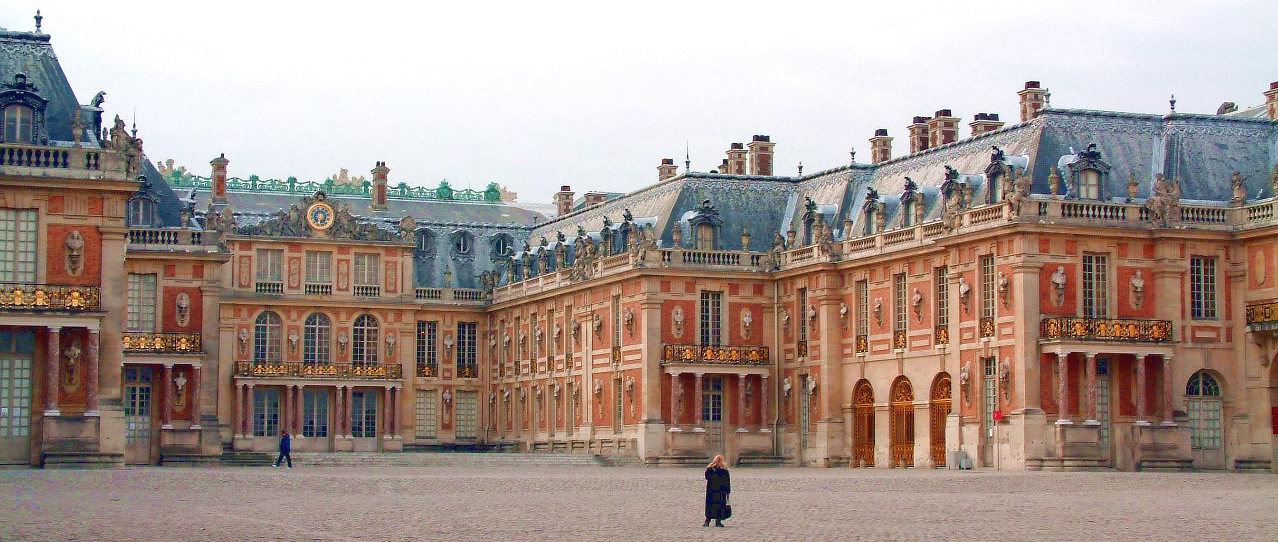
The Pio Ospedale della Pietà in Venice (image below), usually described as an orphanage and music school, was extremely important in Antonio Vivaldi’s life. At the age of 25, Vivaldi was hired by the Pietà as a violin teacher. It was his first “real” job, and his association with the Pietà continued in one form or another for the rest of his life. A great deal of Vivaldi’s music was written for concerts and religious services at the Pietà.

In 1198, Pope Innocent III decreed that homes should be established which would care for orphans and children who had been abandoned. These homes were generally associated with churches and convents. By means of a “baby hatch” or “foundling wheel” (image below), a mother could anonymously deliver a baby, usually a newborn, into the care of the church. The mother would place the baby in a sort of revolving door, rotate the device so that the baby was inside, and then ring a bell to alert those inside that a baby had been delivered. Sometimes babies were abandoned because of a deformity, but more often it was because they had been born out of wedlock.

In fact, as Robert Mealy wrote in last season’s program notes for March 2009’s “Winds and Waves” concerts: the young women had to renounce any professional career once they left the institution.
“These terms meant that there were a good number of women who stayed on in the Pietà, becoming teachers. This all-woman orchestra was enough of a novelty (and their playing was of such exceptional ability) that their performances became one of the attractions of Venice, a standard stop on the Grand Tour of young, well-to-do gentlemen, who delighted in the mystery of hearing these women play behind a “grille” or screen.”
When Antonio Vivaldi was born in 1678, his father Giovanni was a professional violinist employed by the Basilica of San Marco in Venice. Antonio no doubt studied violin with his father and, by time he was a teenager, he was occasionally subbing for his father at San Marco and being hired at the basilica as an extra player for special occasions.
Despite this background in music, Vivaldi’s life seemed to be aimed at the priesthood. He was known during his life as “The Red Priest,” a reference to his red hair. He studied for the priesthood at several churches in Venice beginning when he was 15 years old and was ordained at the age of 25. However, within a few years of his ordination, he permanently stopped celebrating Mass, but still retained his status as a priest (and presumably retained other priestly functions, such as hearing confessions).

Famous 1723 caricature of "Il prete rosso" by Pier Leone Ghezzi.
The reasons for this change are unclear. Vivaldi is known to have suffered all his life from bronchial asthma, which could possibly have interfered with his ability to speak and chant for the duration of a Mass. There is a story, almost certainly spurious, that Vivaldi once left the altar in the middle of Mass to return to the sacristy. In the story, the reason was that a clever fugue subject had just occurred to him and he wanted to write it down before he forgot it. If the story is true, it could also be that he had an asthma attack during Mass and needed to sit down. It is also known that some years later, Vivaldi was censured for conduct unbecoming a priest. Although the reason for Vivaldi’s censure is unclear, it is also possible that the reason was also related to his decision to stop celebrating Mass.
Despite the fact that Vivaldi did not celebrate Mass and despite any difficulties with the church hierarchy, he was known during his life as a pious man and frequently wrote an abbreviation of the religious motto “Laus Deo Beataeque Mariae Deiparae Amen” on his manuscripts.


 We just found out that our friends at the Mondavi Center posted online the pre-concert talk given by Music Director Nic McGegan (pictured left, backstage at Mondavi) and our Bay Area "Prelude" speaker John Prescott.

 Posts
All Comments
Posts
All Comments


