Check them out:
We've been Fall Arts Previewed!
September Program Notes
Videos: Levin on Mozart
What I did on my summer vacation, pt. 1
Thank you for following this blog. Please keep up with us on facebook and our new website.
Showing posts with label Orchestra Musicians. Show all posts
Showing posts with label Orchestra Musicians. Show all posts
August 27, 2010


August 6, 2010
What I did on my summer vacation: Pt. 1
'What have your musicians and singers have been up to all summer?' you ask? Well, let's find out!
 In June, Music Librarian and violist David Daniel Bowes (left) went on vacation with his partner Brian to the Pacific Northwest, where Brian was sick with flu the entire time! When David started to get sick too, “we paid the piper and came home early.” However, after all that, “bliss!” They planted heirloom tomatoes and the dahlias came up in full force and beauty. As he has for nearly 25 years, David played under George Cleve in the Midsummer Mozart Festvial. He is often working from home this summer since he is painting the walls of their Santa Rosa house, with Brian on “food and errand duty.” David says he is “looking very much forward to the start of the Philharmonia Baroque season!”
Angela Arnold, a soprano joining the Chorale this fall, made her first appearance with Open Opera in June, in a free, open-air concert of popular arias at Berkeley's Live Oak Park and has been preparing for a number of recitals in September. She has had a few brief getaways this summer: the Texas Panhandle, where she met some in-laws for the first time (!); her hometown Chicago, where she enjoyed “real summer weather,” including beautiful thunderstorms; and Washington, D.C., where she “baked for hours in the sun” for the chance to catch Gladys Knight and Reba McIntyre performing live on the Capitol's West Lawn for the 4th of July.
 Violinist Carla Moore (left) performed with her chamber group, Music's Re-creation, and her new string band, Archetti Baroque Strings, at the Berkeley Festival. Soon after, she went camping in Canyonlands National Park, southeastern Utah with her family. “It was pure bliss-red rocks and hot sun!” After that she actually had to get back to work – performing J.S. Bach's Orchestral Suites at the Oregon Bach Festival with Monica Huggett and the Portland Baroque Orchestra and teaching at the Amherst Early Music Festival on the East Coast. She’s looking forward to her second camping trip to the Sierras in August, but first she is teaching the “wee ones” violin at the SFEMS Music Discovery Workshop in Berkeley.
Also new to the chorale, alto Jean-Paul Jones worked at a summer camp in the Mendocino Mountains for about three weeks with troubled youth from the Bay Area. “It was an interesting and rewarding experience, but also exhausting.” He is back in San Francisco playing viola with Bay Area Rainbow Symphony (and seeking employment as a bartender).
After what violinist Kati Kyme calls the “whirl-wind of Berkfest concerts,” she took a few days to unwind at Stinson Beach. Her family rented a house, where they were “spoiled to have only a few steps to the beautiful views of Stinson.” Since then, she’s been back working for upcoming performances of Don Giovanni with Open Opera and preparing two weeks of youth orchestra camps. “I am able to sneak in only a little pre-season practicing, but I'm almost ready, psychologically, for the new season to start.”

Angela Arnold, a soprano joining the Chorale this fall, made her first appearance with Open Opera in June, in a free, open-air concert of popular arias at Berkeley's Live Oak Park and has been preparing for a number of recitals in September. She has had a few brief getaways this summer: the Texas Panhandle, where she met some in-laws for the first time (!); her hometown Chicago, where she enjoyed “real summer weather,” including beautiful thunderstorms; and Washington, D.C., where she “baked for hours in the sun” for the chance to catch Gladys Knight and Reba McIntyre performing live on the Capitol's West Lawn for the 4th of July.

Also new to the chorale, alto Jean-Paul Jones worked at a summer camp in the Mendocino Mountains for about three weeks with troubled youth from the Bay Area. “It was an interesting and rewarding experience, but also exhausting.” He is back in San Francisco playing viola with Bay Area Rainbow Symphony (and seeking employment as a bartender).
After what violinist Kati Kyme calls the “whirl-wind of Berkfest concerts,” she took a few days to unwind at Stinson Beach. Her family rented a house, where they were “spoiled to have only a few steps to the beautiful views of Stinson.” Since then, she’s been back working for upcoming performances of Don Giovanni with Open Opera and preparing two weeks of youth orchestra camps. “I am able to sneak in only a little pre-season practicing, but I'm almost ready, psychologically, for the new season to start.”
July 20, 2010
July 15, 2010
Gonzalo in the Wall Street Journal
 One of the volunteers who is helping us with our season ticket mailing mentioned this morning that Gonzalo Ruiz is featured in today's Wall Street Journal. He talks about transcribing Bach's "Orchestral Suite No. 2," with it's famous flute solos, for oboe. We played this back in October 2008 to rave reviews.
Hear for yourself:
June 9, 2010
Congratulations Hanneke!
 We are pleased to announce a recent appointment to the membership of Philharmonia Baroque. Effective next season, Hanneke van Proosdij has been named First-Call Member of the Laurette Goldberg Keyboard Chair, endowed by Anne and David Oliver. Our long time fans will surely recognize Hanneke, who has often played harpsichord, organ, and recorder in the orchestra for the last 13 years.
Hanneke performs regularly as soloist and continuo specialist with Philharmonia Baroque, FestspielOrchester Göttingen, Voices of Music, Concerto Palatino, Magnificat and American Bach Soloists. She has appeared as a guest artist with Hesperion XX, Concerto Köln, Chanticleer, Orchestre dAmbronnay, Gewandhaus Orchester and the Arcadian Academy. She received her solo and teaching diplomas from the Royal Conservatory of The Hague, where she studied recorder, harpsichord and composition.
Together with her husband David Tayler, Hanneke cofounded and codirects Voices of Music. Hanneke is a cofounder of the Junior Recorder Society in the East Bay and was the director of the SFEMS Medieval Renaissance Workshop for seven years and now directs, together with Rotem Gilbert, the SFEMS Recorder Workshop. She has recorded over forty discs for Magnatune, BIS, Koch, Musica Omnia, Carus, AVIE and Delos.
May 19, 2010
Congratulations SFRV!
 Have you picked up your issue SF Weekly's "Your San Francisco?" We just wanted to take a minute to congratulate our early music colleagues San Francisco Renaissance Voices for winning "Best Classical Music – 2010." A few of our Chorale singers sing with SFRV, including Jeff Fields, Raymond Martinez, Kathy McKee (who is also the Assistant Music Director of SFRV - pictured) and Helene Zindarsian.
Glorious sounds of centuries past

On June 10-12, come say hello to us at our table at "BFX TEN" – the 10th bi-annual early music festival, conference and exhibition in Berkeley.
Presented by San Francisco Early Music Society and Early Music America, there will be beautiful performances both as a part of the festival and on "The Fringe" in conjunction with the main stage events. Don't miss members of the orchestra perform in their smaller chamber groups – Magnificat, Music’s Re-creation, Voices of Music, New Esterhazy Quartet, Harmonia Felice, Ensemble Vermillian, Les Violettes, Galax Quartet, Barefoot Chamber Concerts and many more. Click here for the full schedule of events.
March 2, 2010
Like the human voice...
 Though Toronto indie rocker Charles Spearin's Happiness Project is one the most touching explorations of humanity through sound in recent memory, he is not exploring a new idea – musicians and composers have long tried to replicate the beauty of the human voice and patterns of speech instrumentally. In particular, bowed stringed instruments have always been admired for their ability to mimic the human voice.
In anticipation of our concerts this weekend and next, Philharmonia Baroque players David Wilson and Maria Caswell, as well as guest artist Jordi Savall, talk about the voice of early stringed orchestral instruments: Listen to our audio concert prelude.
February 9, 2010
Announcing 2010-11 – Our 30th Anniversary Season
Today, we announced our 30th Anniversary Season!
Current subscribers can renew their subscriptions now! General public subscriptions go on sale March 15th! Single tickets go on sale August 5th. Keep checking our website, more information will be up in the coming weeks. If you can't wait... you can always join us this weekend for Brahms (just in time for Valentine's)!

Philharmonia Baroque Orchestra and Chorale's
2010-11 Season
* – Philharmonia Baroque premiere
† – Philharmonia Baroque debut
Friday 24 September Herbst Theatre, San Francisco
Saturday 25 September First Congregational Church, Berkeley
Sunday 26 September First Congregational Church, Berkeley
Tuesday 28 September Menlo-Atherton Performing Arts Center, Atherton
Wednesday 29 September Lesher Center for the Arts, Walnut Creek
Nicholas McGegan, conductor
Robert Levin, fortepiano (below)
MOZART
Incidental Music from Thamos, King of Egypt *
Concerto for Fortepiano No. 20 in D minor, K. 466 *
Fragments of newly found works for Fortepiano and Orchestra (U.S. Premiere)
Symphony No. 41 in C major, KV 551 “Jupiter” (Last performed by Philharmonia Baroque on March 2001)

October – Bach’s Wedding Cantata
Friday 15 October Herbst Theatre, San Francisco
Saturday 16 October First Congregational Church, Berkeley
Sunday 17 October First Congregational Church, Berkeley
Tuesday 19 October Menlo-Atherton Performing Arts Center, Atherton
Lars Ulrik Mortensen, conductor and harpsichord (below) †
Maria Keohane, soprano †
BACH
Orchestral Suite No. 1 in C major, BWV 1066
Concerto for Harpsichord in D minor, BWV 1052
“Weichet nur, betrübte Schatten,” Wedding Cantata, BWV 202 (February 1982 – Philharmonia Baroque’s first public concert)
Concerto for Harpsichord in D major, BWV 1054

November – Vivaldi’s Four Seasons
November – Vivaldi’s Four Seasons
Friday 5 November Herbst Theatre, San Francisco
Saturday 6 November First Congregational Church, Berkeley
Sunday 7 November First Congregational Church, Berkeley
Tuesday 9 November Menlo-Atherton Performing Arts Center, Atherton
Wednesday 10 November Lesher Center for the Arts, Walnut Creek
Nicholas McGegan, conductor
Elizabeth Blumenstock, violin (concertmaster)
VIVALDI The Four Seasons, Op. 8, Nos. 1-4 (March 1991)
CORELLI Concerto Grosso Op. 6, No. 11 in B-flat major
PERGOLESI Sinfonia in F major *
DURANTE Concerto No. 5 in A major *
ZAVATERI Concerto decimo a Pastorale, Op. 1 *

December – Handel’s Messiah
Friday 3 December Herbst Theatre, San Francisco
Saturday 4 December First Congregational Church, Berkeley
Sunday 5 December First Congregational Church, Berkeley
Tuesday 7 December Menlo-Atherton Performing Arts Center, Atherton
Nicholas McGegan, conductor
Daniel Taylor, countertenor
John McVeigh, tenor
Tyler Duncan, bass †
Philharmonia Chorale, Bruce Lamott, director
TBA soprano
HANDEL Messiah (December 2002)

January – David Daniels

January – David Daniels
Saturday 15 January First Congregational Church, Berkeley
Sunday 16 January First Congregational Church, Berkeley
Tuesday 18 January Menlo-Atherton Performing Arts Center, Atherton
Friday 21 January Herbst Theatre, San Francisco
Nicholas McGegan, conductor
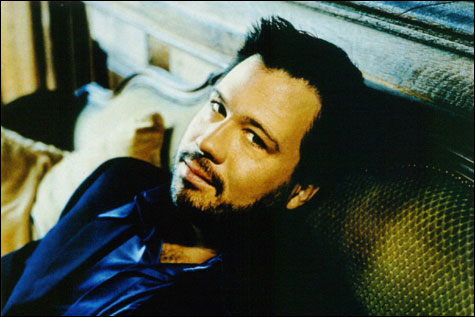
David Daniels, countertenor (below)
VIVALDI Stabat mater, RV 621 *
HANDEL Arias from Giulio Cesare
TELEMANN Suite in F major, TWV 55:F11 “Alster Overture” *
February – Hummel’s Concerto for Keyed Trumpet
Friday 11 February Herbst Theatre, San Francisco
Saturday 12 February First Congregational Church, Berkeley
Sunday 13 February First Congregational Church, Berkeley
Tuesday 15 February Menlo-Atherton Performing Arts Center, Atherton
Nicholas McGegan, conductor
Gabriele Cassone, keyed trumpet (below)†
SPOHR Symphony No. 2 in D minor, Op. 49 *
HUMMEL Concerto for Keyed Trumpet in E major *
MENDELSSOHN Symphony No. 1 in C minor, Op. 11 *

March – Flicka!
Friday 4 March Herbst Theatre, San Francisco
Saturday 5 March First Congregational Church, Berkeley
Sunday 6 March First Congregational Church, Berkeley
Tuesday 8 March Menlo-Atherton Performing Arts Center, Atherton
Wednesday 9 March Lesher Center for the Arts, Walnut Creek
Nicholas McGegan, conductor
Frederica von Stade, mezzo-soprano (below)†
REBEL Les Caractères de la danse *
Nathaniel STOOKEY Into the Bright Lights (poetry by Flicka) (U.S. Premiere)
RAMEAU Les Indes galantes suite d’orchestre
GLUCK Arias

April – Haydn’s Creation
Friday 8 April Herbst Theatre, San Francisco
Saturday 9 April First Congregational Church, Berkeley
Sunday 10 April First Congregational Church, Berkeley
Tuesday 12 April Menlo-Atherton Performing Arts Center, Atherton
Wednesday 13 April Lesher Center for the Arts, Walnut Creek
Nicholas McGegan, conductor
Dominique Labelle, soprano
Thomas Cooley, tenor
Philharmonia Chorale, Bruce Lamott, director
HAYDN The Creation (April 1994)

Celebrating 30 Years of Inspired Sound
When Philharmonia Baroque Orchestra of the West played the first notes of Johann Sebastian Bach’s Wedding Cantata at Herbst Theatre on February 4, 1982, no one guessed what the future would hold. At the time, just having formed the first period instrument ensemble on the West Coast was a feat in itself. By the mid-1970s, a small community of musicians and craftsmen had converged on the Bay Area, all inspired by a countercultural phenomenon: the early music movement. It was not until a fateful moment in 1977 that the true power of this rediscovered period of music was realized at a summer camp on the Russian River—a roomful of these musicians played together as an ensemble, on period instruments, for the very first time. They produced a sound so full of life, expression, exuberance, clarity and subtlety that it seemed to vibrate from the hearts and minds of the composers.
The moment was so moving, so unique, that one musician—Laurette Goldberg—became obsessed with creating an orchestra that would be able to recreate the richness, brilliance, flexibility and articulation that the composers of the Baroque and early Classical periods intended. Laurette spent five years bringing together a group of people who would support the musicians who became Philharmonia Baroque. At thetime, her ideas were radical—a chamber orchestra, Baroque and early-Classical repertoire, period instruments, but her desire was not—to create something meaningful, affecting, transcendent.
Since the very beginning, Philharmonia Baroque has been about the love of a sound—a sound, once heard, that changes once and for all the way we want to experience music, whether on stage or in the audience. This inspiration has guided Philharmonia Baroque from the start, and the organization’s ultimate goal has remained constant since its inception 30 years ago: we want our music to delight, to inspire and to educate—to increase the level of beauty, sensitivity and joy in a complex world.
We hope to see you this season and next!
November 23, 2009
Behind the scenes of "The Passion of Dido:" Rehearsal at Walt Disney Hall
This is the last post about November's concert, we promise! Here are pictures from our rehearsal at Walt Disney Hall in L.A.!


Since the supertitles say, "but, ah! I fear, I pity his too much," we must be in the first act.
Let's skip ahead to our favorite parts: Jill Grove sings the SORCERESS: "Appear at my call, and share in the Fame/Of a Mischief shall make all Carthage flame./Appear!"
The Chorale sings the FAIRIES: "Ho, ho, ho, ho, ho, ho!"
William Berger sings AENEAS: "What shall lost Aeneas do?" (Of course, Susan Graham's DIDO doesn't buy the self pity. You can see in her face that she's about to deliver one of our favorite lines: "Thus on the fatal Banks of Nile,/ Weeps the deceitful Crocodile.")
Susan Graham sings DIDO's lament: "Death is now a welcome guest."
November 17, 2009
Behind the scenes of "The Passion of Dido:" Rehearsal at Mondavi
This past Saturday at the Mondavi Center in Davis, Philharmonia Baroque Orchestra and Chorale performed the final concert of their critically-acclaimed program dedicated to the English composer Henry Purcell. Conducted by Music Director Nicholas McGegan, the concert featured the all-sung masque Dido and Aeneas with mezzo-soprano Susan Graham, baritone William Berger, sopranos Cyndia Sieden and Céline Ricci, contralto Jill Grove and one of the Chorale's own tenors – Brian Thorsett. We captured a few shots backstage and during the dress rehearsal. Local photographer Randi Lynn Beach was on hand to take much better photos than ours to help publicize our 30th Anniversary (!!!) next season.

Say "historically informed performance!" Say "continuo harpsichord!" How about just "cheeeeese!" Randi shoots Nic at the harpsichord.

Randi shoots the orchestra as they practice Purcell's perky Suite from Abdelazar, a rather bizarre and gruesome play by Aphra Behn.

Nic warms up the orchestra's smile muscles during a short interlude. They don't call him the "sunniest conductor in classical music" for nothing.
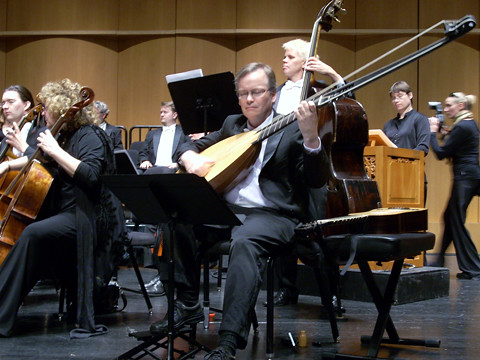
Randi swoops in for another shot while the orchestra rehearses. Left to right, cellists Bill and Phoebe, lutist David (on theorbo), bassist Kristin and organist Hanneke.

Our show stealers: the Chorale!
November 2, 2009
Learn more about our November concerts
 "The Passion of Dido," Philharmonia Baroque Orchestra's third concert of its 2009-10 "Season of the Stars," is THIS WEEK! Music Director Nic McGegan (pictured left) leads our orchestra and chorale in a program that honors the life of the English composer and songwriter Henry Purcell. Featured on the second half of the program is Dido and Aeneas with renowned mezzo-soprano Susan Graham singing the role of Dido and also William Berger, Cyndia Sieden, Celine Ricci, Jill Grove and Brian Thorsett. In it's last issue, Early Music America Magazine wrote about our recording of Dido and Aeneas: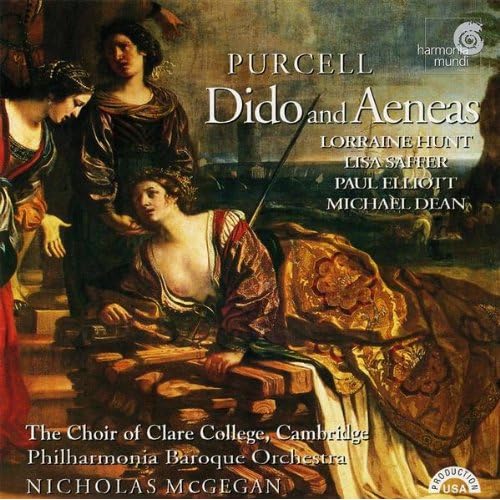
What is, to my mind, the finest Dido and Aeneas recording currently available features an American cast and orchestra. The 1993 Harmonia Mundi recording with the late mezzo-soprano Lorranie Hunt Lieberson in the title role has it all. For sheer gorgeous vocalism wed to dramatic intensity, Lieberson is unsurpassed. Her every phrase and gesture carries weight. Lieberson's singing of the lament? I had to sit in silence afterward and collect myself... This recording, with [Nicholas] McGegan leading a remarkably responsive Philharmonia Baroque Orchestra, cuts to the heart of the work. The Dido and Aeneas (sung by baritone Michael Dean) exchange in Act III seethes, and Lieberson's cry of 'By all that's good!' is shattering. For once, the roles of the Sorceress (mezzo-soprano Ellen Rabiner) and the Witches (sopranos Christine Brandes and Ruth Rainero) are colorful but not so broad as to descend into Monty Python parody."
As for the concert, it has named a top pick of the fall by critics and editors of the Chronicle, KQED, Mercury News, Examiner and Classical Voice. San Francisco Classical Voice previewed it in last week's enewsletter:
"McGegan and the orchestra are buoyed, not bowed down, by their specialist knowledge, and undaunted by the technical difficulties of some of the older instruments. They master intricate rhythmic and phrasing details that you don’t normally hear from modern instrument orchestras, yet play them with a conviction and ease that sounds natural. McGegan’s adrenaline-filled gestures transmit his excitement, and the orchestra normally responds by lifting you out of your seat. This is music-making by people who have been to the early-music revolution and come back enriched." Read more of Michael Zwiebach's preview.
To learn more about this concert, click the links below:
Click to read our program notes.You can also listen to selections from our recording of Dido and Aeneas on November's concert page. Hint: when you click on "Learn more about these recordings," you can read about these works!
An don't forget: 45-minutes before every concert we offer free lectures to our ticket holders.
October 20, 2009
One of these people is not like the others... Comparing period and modern violin[ist]s (Part 3)
During the last concert set, David Wilson asked his colleagues in the violin and viola sections of Philharmonia Baroque the most important question about the difference between the baroque violin and modern violin: not about construction, nor about how the instruments are held or played, but what makes a period violinist:
"As far as I know, no one has yet begun their violinistic career as a baroque violinist. We are trained as modern violinists and at some point along the way we discover this other path and begin to pursue it (I sometimes call this ‘going over to the Dark Side’). Doing so requires an open-mindedness, a willingness to try new things and possibly to discard a great deal of habit. Making the switch involves a great deal of time, effort, and even expense on the part of a player.
"So, why bother? I asked that question of a number of my fellow musicians, and here are some of the answers I got:
Baroque instruments are ‘native speakers’ of the musical rhetoric of their time. In original ‘dialects,’ they enable musicians to delve into and to genuinely articulate the elegance, emotional power and humor in baroque music.It is the subtle, sensuous responsiveness that always draws me to the baroque violin. While playing on gut and especially while using a baroque bow, I feel I have a greater range of musical color, a more fleet, capricious ability to show the ever-changing character and mood of the music.— Katherine Kyme‘the baroque violin’or, as it was called in the 18th century‘the modern violin’we use baroque instruments as means for a shamanistic exploration of the ways of our ancestors– as the hunter dances in imitation of the game, in order to become the game –we bring the words of our ancestors to our lips via their writingswe look through their eyes into their paintings and drawingswe put our ancestors’ hands before our eyes via facsimileswe grasp their tools in our hands via their instrumentsand so we attempt to reenter their worldor invite their spirits into oursand thus reanimatetheir voicesin our earsI am able to do much more nuanced playing with the baroque bow, and the lower tension on the strings allows me to draw out a singing tone without effort. My baroque instruments, geared for chamber music and small orchestras, are more personable, intimate, individually expressive... and the best thing is you don't have to constantly shake the note to make it sing!— Maria Caswell
Every culture has created its own particular sound world; and none of them are the same, all are unique. I suspect that many of us who love Baroque instruments have some desire to visit the people of that lost world, a curiosity and love which is somewhat satisfied in the playing of ‘their’ instruments in a way ‘they’ might have recognized.
Of course, we couldn't couldn't post this blog without asking David the same question he posed to his colleagues: Why baroque violin, David?
The first time I ever heard baroque music on period instruments, I literally had chills running down my spine and tears running down my face—I was profoundly moved by the sound of the instruments and the way that sound showed the power of the music. For me it was like having heard poetry read by a voice synthesizer, and then hearing it read by a poet. I knew I wanted to learn how to make music in that way.— David Wilson
Subscribe to:
Posts (Atom)


 Posts
Posts


