Check them out:
We've been Fall Arts Previewed!
September Program Notes
Videos: Levin on Mozart
What I did on my summer vacation, pt. 1
Thank you for following this blog. Please keep up with us on facebook and our new website.
Showing posts with label Listen to Music. Show all posts
Showing posts with label Listen to Music. Show all posts
August 27, 2010


July 15, 2010
Gonzalo in the Wall Street Journal
 One of the volunteers who is helping us with our season ticket mailing mentioned this morning that Gonzalo Ruiz is featured in today's Wall Street Journal. He talks about transcribing Bach's "Orchestral Suite No. 2," with it's famous flute solos, for oboe. We played this back in October 2008 to rave reviews.
Hear for yourself:
March 2, 2010
Like the human voice...
 Though Toronto indie rocker Charles Spearin's Happiness Project is one the most touching explorations of humanity through sound in recent memory, he is not exploring a new idea – musicians and composers have long tried to replicate the beauty of the human voice and patterns of speech instrumentally. In particular, bowed stringed instruments have always been admired for their ability to mimic the human voice.
In anticipation of our concerts this weekend and next, Philharmonia Baroque players David Wilson and Maria Caswell, as well as guest artist Jordi Savall, talk about the voice of early stringed orchestral instruments: Listen to our audio concert prelude.
November 2, 2009
Learn more about our November concerts
 "The Passion of Dido," Philharmonia Baroque Orchestra's third concert of its 2009-10 "Season of the Stars," is THIS WEEK! Music Director Nic McGegan (pictured left) leads our orchestra and chorale in a program that honors the life of the English composer and songwriter Henry Purcell. Featured on the second half of the program is Dido and Aeneas with renowned mezzo-soprano Susan Graham singing the role of Dido and also William Berger, Cyndia Sieden, Celine Ricci, Jill Grove and Brian Thorsett. In it's last issue, Early Music America Magazine wrote about our recording of Dido and Aeneas: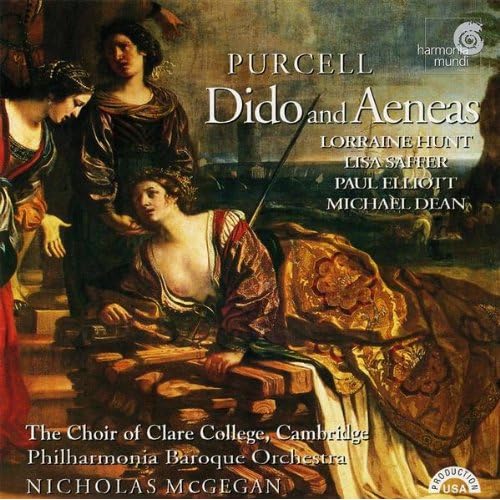
What is, to my mind, the finest Dido and Aeneas recording currently available features an American cast and orchestra. The 1993 Harmonia Mundi recording with the late mezzo-soprano Lorranie Hunt Lieberson in the title role has it all. For sheer gorgeous vocalism wed to dramatic intensity, Lieberson is unsurpassed. Her every phrase and gesture carries weight. Lieberson's singing of the lament? I had to sit in silence afterward and collect myself... This recording, with [Nicholas] McGegan leading a remarkably responsive Philharmonia Baroque Orchestra, cuts to the heart of the work. The Dido and Aeneas (sung by baritone Michael Dean) exchange in Act III seethes, and Lieberson's cry of 'By all that's good!' is shattering. For once, the roles of the Sorceress (mezzo-soprano Ellen Rabiner) and the Witches (sopranos Christine Brandes and Ruth Rainero) are colorful but not so broad as to descend into Monty Python parody."
As for the concert, it has named a top pick of the fall by critics and editors of the Chronicle, KQED, Mercury News, Examiner and Classical Voice. San Francisco Classical Voice previewed it in last week's enewsletter:
"McGegan and the orchestra are buoyed, not bowed down, by their specialist knowledge, and undaunted by the technical difficulties of some of the older instruments. They master intricate rhythmic and phrasing details that you don’t normally hear from modern instrument orchestras, yet play them with a conviction and ease that sounds natural. McGegan’s adrenaline-filled gestures transmit his excitement, and the orchestra normally responds by lifting you out of your seat. This is music-making by people who have been to the early-music revolution and come back enriched." Read more of Michael Zwiebach's preview.
To learn more about this concert, click the links below:
Click to read our program notes.You can also listen to selections from our recording of Dido and Aeneas on November's concert page. Hint: when you click on "Learn more about these recordings," you can read about these works!
An don't forget: 45-minutes before every concert we offer free lectures to our ticket holders.
October 9, 2009
One of these things is not played like the other... Comparing period and modern violins (Part 2)
Now that we have some idea how a baroque violin is built differently than a modern one, we've asked David Wilson to explain the differences between playing period violins and modern violins:
"What makes a baroque violinist? Having period-appropriate equipment (violin and bow) is the beginning, but playing the baroque violin also calls for very different techniques than the modern violin.
"While watching the violin sections of Philharmonia Baroque Orchestra perform, the first thing you might notice is that the baroque violin is held differently. The end of the violin rests on the player’s collarbone at one end and is supported by the player’s left hand at the other, rather than being held between the chin and the shoulder like a modern violin. The result is that the player’s head is free to assume a natural, relaxed position while playing."
Click to watch a video in which you can see how period violinists hold their instruments (you may recognize all of the musicians, they all perform with PBO!). Compare this to how modern violin teacher and professor Todd Ehle instructs his virtual students how to hold their instruments.
"The leader and soloist for PBO’s October concert set, violinist Elizabeth Wallfisch, is one of the leading proponents of the 'chin-off' approach to baroque violin playing, in which the player’s head never touches the violin. All changes of left-hand position are accomplished by means of a graceful ballet of sliding and pivoting.
Click here to listen to period violinist Rachel Podger explain some more of the differences between playing period and modern violins.
October 2, 2009
Beer and Baroque a success!
Our first Beer and Baroque Series event featuring the Universal Piston Horn Quartet (PBO horn players R.J. Kelley, Paul Avril, John Boden, Alexandra Cook) and special guest Fred Holmgren was a sell out! Thank you organizers Michael Colbruno and Brian Gould, as well as sponsor Pyramid Alehouse, Brewery and Restaurant in Berkeley.

August 7, 2009
Preview our 2008-09 Season Highlights
What were some your most memorable moments of last season? One of the staff's favorites was hearing how wonderfully different Bach's Orchestral Suite No. 2 in A minor sounded when played by oboe, not flute. Hear it for yourself:Read more about why Gonzalo reconstructed the piece for oboe.
What were your favorite moments from our 28th Season?
*These clips are from our 2008-09 Season Highlights CD, which is made available exclusively to PBO's generous members who made donations last year. Learn more about how you can support our music and education programs.
Subscribe to:
Posts (Atom)


 Posts
Posts


