November 30, 2009

The Red Priest

With December nearly upon us, Philharmonia Baroque Orchestra and Chorale are already rehearsing for their next concert: "Gloria! A Holiday Celebration." This concert features primarily sacred works and pastorales by Italian Baroque masters, focusing on one of our favorite Baroque violinists: Antonio Vivaldi. Violinist and Philharmonia Baroque staffer David Wilson is back to fill us in about the composer who did more than just make music for the church:

When Antonio Vivaldi was born in 1678, his father Giovanni was a professional violinist employed by the Basilica of San Marco in Venice. Antonio no doubt studied violin with his father and, by time he was a teenager, he was occasionally subbing for his father at San Marco and being hired at the basilica as an extra player for special occasions.

Despite this background in music, Vivaldi’s life seemed to be aimed at the priesthood. He was known during his life as “The Red Priest,” a reference to his red hair. He studied for the priesthood at several churches in Venice beginning when he was 15 years old and was ordained at the age of 25. However, within a few years of his ordination, he permanently stopped celebrating Mass, but still retained his status as a priest (and presumably retained other priestly functions, such as hearing confessions).

Famous 1723 caricature of "Il prete rosso" by Pier Leone Ghezzi.

The reasons for this change are unclear. Vivaldi is known to have suffered all his life from bronchial asthma, which could possibly have interfered with his ability to speak and chant for the duration of a Mass. There is a story, almost certainly spurious, that Vivaldi once left the altar in the middle of Mass to return to the sacristy. In the story, the reason was that a clever fugue subject had just occurred to him and he wanted to write it down before he forgot it. If the story is true, it could also be that he had an asthma attack during Mass and needed to sit down. It is also known that some years later, Vivaldi was censured for conduct unbecoming a priest. Although the reason for Vivaldi’s censure is unclear, it is also possible that the reason was also related to his decision to stop celebrating Mass.

Despite the fact that Vivaldi did not celebrate Mass and despite any difficulties with the church hierarchy, he was known during his life as a pious man and frequently wrote an abbreviation of the religious motto “Laus Deo Beataeque Mariae Deiparae Amen” on his manuscripts.

Editor's Note: We think that might mean "Praise God, the blessed Mary, and the Son of God. Amen." However, we're not sure. Do you know? Most of us are a bit rusty with our Latin (if we ever took it in the first place).

November 23, 2009

Behind the scenes of "The Passion of Dido:" Rehearsal at Walt Disney Hall

This is the last post about November's concert, we promise! Here are pictures from our rehearsal at Walt Disney Hall in L.A.!
Since the supertitles say, "but, ah! I fear, I pity his too much," we must be in the first act.

Let's skip ahead to our favorite parts: Jill Grove sings the SORCERESS: "Appear at my call, and share in the Fame/Of a Mischief shall make all Carthage flame./Appear!"

The Chorale sings the FAIRIES: "Ho, ho, ho, ho, ho, ho!"

William Berger sings AENEAS: "What shall lost Aeneas do?" (Of course, Susan Graham's DIDO doesn't buy the self pity. You can see in her face that she's about to deliver one of our favorite lines: "Thus on the fatal Banks of Nile,/ Weeps the deceitful Crocodile.")

Susan Graham sings DIDO's lament: "Death is now a welcome guest."

More pictures on flickr.

Behind the scenes of "The Passion of Dido:" Lecture at Mondavi

We just found out that our friends at the Mondavi Center posted online the pre-concert talk given by Music Director Nic McGegan (pictured left, backstage at Mondavi) and our Bay Area "Prelude" speaker John Prescott.

Hear it now below!


November 17, 2009

Behind the scenes of "The Passion of Dido:" Rehearsal at Mondavi

This past Saturday at the Mondavi Center in Davis, Philharmonia Baroque Orchestra and Chorale performed the final concert of their critically-acclaimed program dedicated to the English composer Henry Purcell. Conducted by Music Director Nicholas McGegan, the concert featured the all-sung masque Dido and Aeneas with mezzo-soprano Susan Graham, baritone William Berger, sopranos Cyndia Sieden and Céline Ricci, contralto Jill Grove and one of the Chorale's own tenors – Brian Thorsett. We captured a few shots backstage and during the dress rehearsal. Local photographer Randi Lynn Beach was on hand to take much better photos than ours to help publicize our 30th Anniversary (!!!) next season.

Say "historically informed performance!" Say "continuo harpsichord!" How about just "cheeeeese!" Randi shoots Nic at the harpsichord.


Randi shoots the orchestra as they practice Purcell's perky Suite from Abdelazar, a rather bizarre and gruesome play by Aphra Behn.


Nic warms up the orchestra's smile muscles during a short interlude. They don't call him the "sunniest conductor in classical music" for nothing.


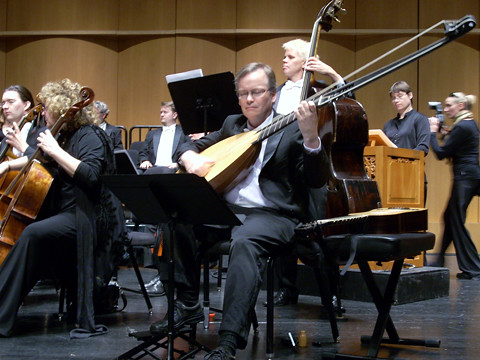
Randi swoops in for another shot while the orchestra rehearses. Left to right, cellists Bill and Phoebe, lutist David (on theorbo), bassist Kristin and organist Hanneke.


Our show stealers: the Chorale!

See the rest of the photos on flickr!

November 11, 2009

Dido in L.A. tonight

With most of the staff down in L.A. for the concert tonight, it's quiet in the Philharmonia Baroque offices today:

That's our Patron Services Manager David Challinor off in the distance.

In case you haven't read it yet, here's the
L.A. Times interview that had us snorting into our coffee this weekend: Susan Graham experiences Dido's hard life with a lounge lizard

Pssst... a great quote that didn't appear in the article: Susan Graham's Nightmare

November 10, 2009

The reviews are in...

And this past weekend's concerts were:
... extraordinary... time stopped...
... incredibly emotional... spine-tingling...
... masterful... aching, bittersweet...
... remarkably unified and rhythmically rousing...
... scintillating...
... so poignant...

Our favorite comment came from San Francisco Classical Voice:
"As wonderful as she was, the evening was decidedly not about Susan Graham. It was a program of glorious music by Britain’s favorite native-born son, presented by one of the world’s great period instrument groups. When Dido urged us to remember her, the sentiment was surely superfluous. Sunday’s concert was hardly an event that we were apt to forget."
Read the reviews.

You have two more chance to see the concert in L.A. and Davis!

November 5, 2009

Tonight's the night!

Tonight, our orchestra and chorale perform the first concert of our November program that features Dido and Aeneas and other works by the beloved English composer Henry Purcell. In celebration of the anniversary of the composer's birth (350 years ago this fall!), Music Director Nicholas McGegan conducts Susan Graham (left) and a stellar cast of singers at Herbst Hall in San Francisco. It would be an understatement to say that we are giddy with anticipation here in the office.

Here are a few distractions to help while away your afternoon:

If you haven't seen the cover story of the Chronicle's new "Ovation" section today, critic Joshua Kosman "hailed the queen" in his interview with Susan Graham.

Also out this week, interviews with Susan on Classical Voice and SFist.com.

The concert was also previewed by the Examiner and on Classical Voice.

See photos from the Susan and Nic's interview with the L.A. Times this past weekend... look for the article this weekend!


See you tonight!