Michael Wyatt joins us for the final post on Orlando furioso (read Parts 1 & 2):
A mere summary does little justice to the dazzling linguistic and conceptual texture of Ariosto’s great poem, elaborated in almost 40,000 lines through a complex network of narrative threads and a cast of thousands.

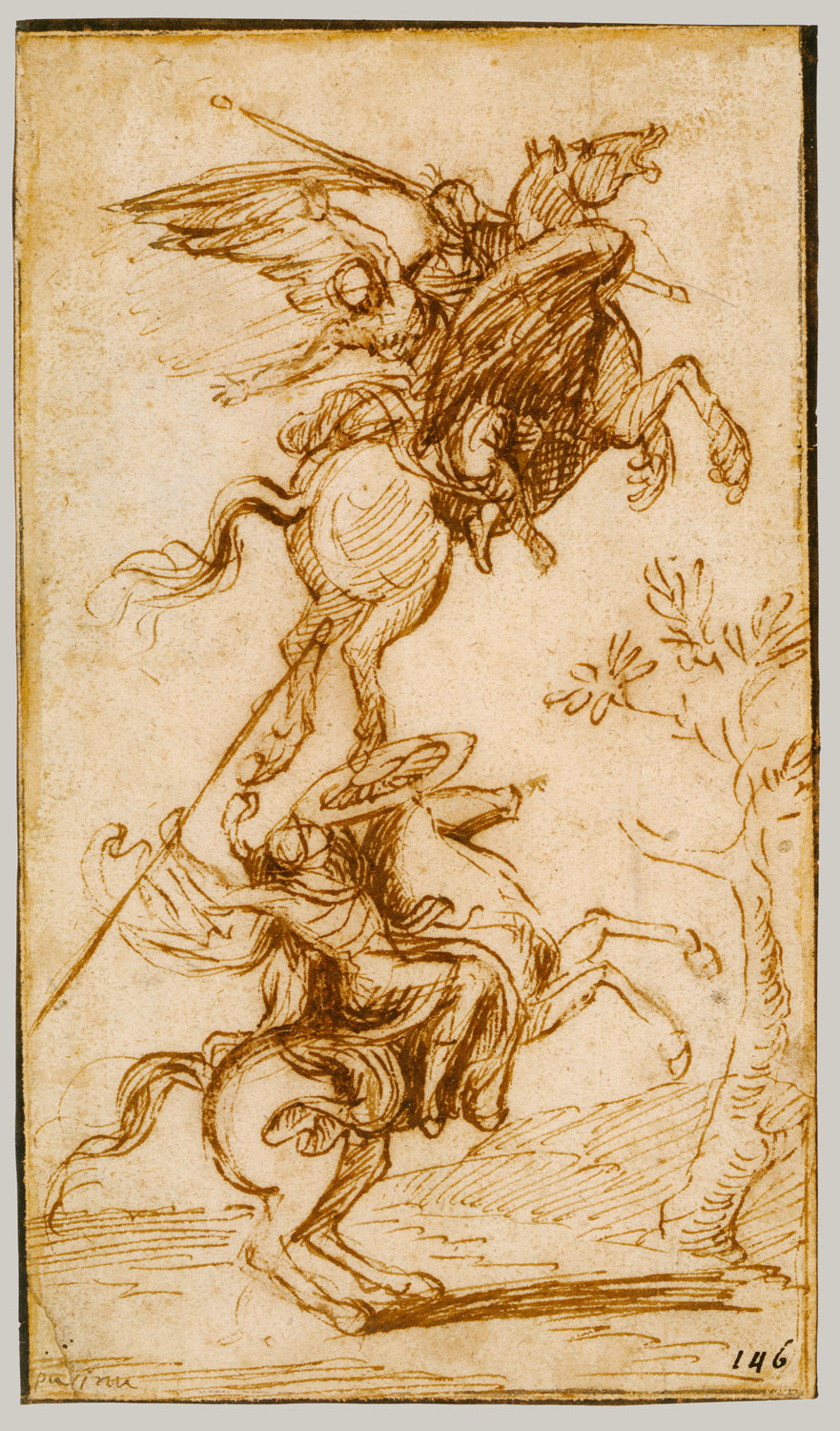
"The Sorcerer Altante Abducting Pinabello's Lady" by Nicolas Poussin (French, 1594–1665)
Orlando furioso was one of the run-away publishing successes of the early modern period. The poem appeared in almost fifty separate editions in Italian in the sixteenth and seventeenth centuries (many of them reprinted many times over), but the Furioso has exercised an equally strong attraction translated into foreign languages. By the early twentieth century, there had been almost ninety versions – partial and complete – in French, twenty-nine in Spanish (it is one of the few books Don Quixote saves from his bonfire of the vanities), some twenty in Russian, thirty in German and eighteen in English. There have been translations of Orlando furioso into Czech, Latin, Hungarian, Portuguese, Dutch, Polish and Hebrew; the first Asian translation seems to be the one published in Japanese in 2002.

En Espanol!
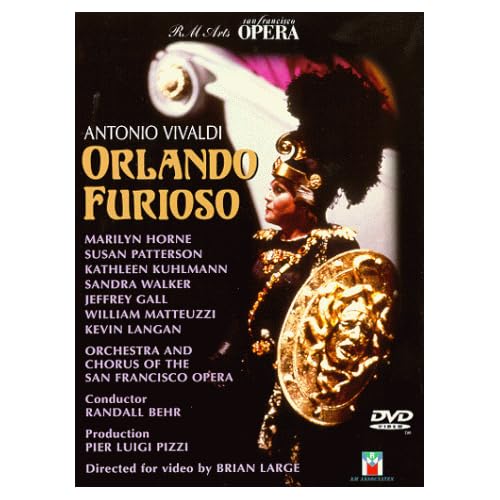
Ariosto’s poem has had an equally rich history of re-elaboration in other forms, giving rise to a veritable industry of literary imitations and responses, visual representations and adaptations for the theater, film, television and radio. Handel wrote three operas to libretti based on the Furioso – Alcina, Ariodante, and Orlando – and composers as varied as Francesca Caccini, Lully, Porpora, Vivaldi, Rameau, and Haydn have found in Ariosto a deep vein of inspiration. Ariosto’s enduring fascination is evident today in the chivalric repertory of the Sicilian puppet theater, the opera dei pupi, a tradition that emerged on the island in the early nineteenth century and continues to be practiced today by several companies in Catania and Palermo.

 Today, our Music Director Nic (left) conducted the final performance of the Göttingen International Handel Festival – the dark opera Tamerlano (HWV 18). Nic has led the Festival as its Music Director for the last 20 years. In 1991, he was passed the baton (figuratively of course, Nic doesn't use a baton as you may remember) by Sir John Eliot Gardiner. Next year, Nic will pass the honors of leading the Festival to (fittingly) yet another British conductor – Laurence Cummings. This year was the Festival's 90th year – to learn more about the festival, watch this video.





 Posts
Posts


