
April 8, 2010
Meet Goldilocks
Today, in the San Francisco Chronicle's "Props" column, Joshua Kosman profiled the harpsichord with a stage presence that can only rival its owner – our Music Director Nic! Here "Goldilocks" is in a photo taken shortly after she was built in 1996:


Written in his spare time: Exploring Orlando Furioso Part 1
In our last blog post, we mentioned Stanford University's symposium "Mad Orlando's Legacy," which will explore the immense impact of the epic poem Orlando furioso by Ludovico Ariosto, which also happens to be the source material for our April concerts featuring Handel's Orlando. To help us explore the connection between the Renaissance poem and the baroque opera, Michael Wyatt (Associate Director of the Center for Medieval and Early Modern Studies at Stanford University) joins us for a three part blog post. His first is about the author of this epic poem with it's own epic story:

Though now recognized as one of the towering figures of Italian Renaissance culture, Ludovico Ariosto (1474-1533) spent his working life in the service of the Este lords of Ferrara. This city, north of Bologna, is now a sleepy university town but in the early modern period was at the cross-roads of a vast European struggle to gain control of the Italian peninsula, and Ariosto’s great epic poem, Orlando furioso (Mad Orlando), registers these conflicts in multiple ways.
Ariosto was born into a minor aristocratic family and studied both law and classical literature, but the premature death of his father exposed the precariousness of the family’s financial situation and compelled Ludovico into the role of bread-winner for a large clan, first as a diplomat, then as the governor of Este-controlled territories in the isolated mountainous region of the Garfagnana (to the north and east of Lucca), and finally back in Ferrara as master of ceremonies and entertainments for the Este court.
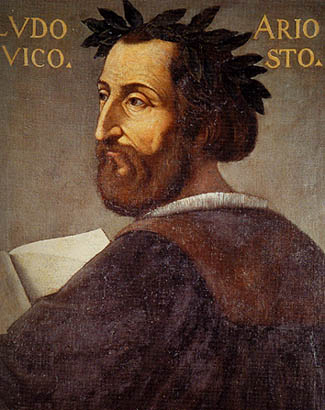
As with so many other major Renaissance writers, Ariosto’s extraordinary literary work was accomplished amidst other – frequently onerous – responsibilities, and Orlando furioso slowly took shape over the course of three decades. First published in 1516, Ariosto continued tinkering with his poem and brought out expanded versions of it in 1521 and 1532. In addition to the Furioso, Ariosto wrote other poetry – in both Italian and Latin – and he was among the first to write stage comedies in a European vernacular language. A series of Satires provide biting send-ups of some of the most prominent figures in Ariosto’s world (including the reigning pope, Leo X, or Giovanni de’ Medici).
March 30, 2010
Forever mad: The Legacy of Orlando Furioso
38,736 lines of poetry collected into 46 cantos make up one of Western culture's most influential works of literature – Ludovico Ariosto's epic poem Orlando Furioso. Written and rewritten over the course of 26 years, this masterpiece once inspired operas, plays, poems, novels, art work and, of course, plenty of copy cats. Ariosta's work "of loves and ladies, knights and arms... of courtesies, and many a daring feat" was actually a sequel of Matteo Maria Boiardo's unfinished romance Orlando Innamorato, which fused the French legends Charlemagne with the English legends of King Arthur.


Until recently though, many in our office hadn't even heard of the poem, the source material, for Handel's opera Orlando (and a couple others too). Well, thank goodness for us (and you), Stanford University's Center for Medieval and Early Modern Studies is hosting a symposium this spring about this poem and its legacy, which includes a conversation with Nic about Handel's Orlando and a performance by the Sicilian puppet company Figli d'Arte Cuticchio. Learn more.
March 19, 2010
Into the crazy world of Orlando: From our Handel expert (and Music Director) Nic McGegan
Nicholas McGegan joins us again to let us know what's so special about George Frideric Handel's opera Orlando, which the orchestra and chorale will perform in April:

Pictured above is the autographed score of Orlando, one of a series of so-called magic operas by Handel. While the sources of many of his plots are derived from classical history or mythology, the 1733 opera Orlando (as well as Ariodante and Alcina, both of 1735) is based on an Italian epic poem from the Renaissance – Orlando furioso by Ludovico Ariosto. Its story is one of extravagant valour and passion taken to the point of madness. Indeed, one could say that works in this genre were parodied by Cervantes in Don Quixote.

Extravagance, passion and madness are, of course, the life blood of opera and it is clear that Handel was inspired by the subject to produce one of his finest works. This is the last opera he wrote for the great alto castrato Senesino (left) for whom he had composed operas for a dozen years. Senesino was a difficult character but a superb singer and, unlike Farinelli, a splendid actor. This must have been a perfect role for him. The Mad Scene that forms the climax to the Second Act is one of the moments of Baroque Opera. Gone are all the normal conventions of the genre, even normal rhythms go awry as Orlando descends (in his own deluded mind) into Hell in five/eight time.
Into this crazy world, Handel, or rather his librettist, introduces two characters who are not found in Ariosto’s original. One is the magus Zoroastro who watches over the mad Orlando and eventually cures him of his insane love for Angelica. He is a wise father figure who will reappear in the Magic Flute as Sarastro. The other is the shepherdess Dorinda who represents an ordinary ‘down to earth girl’ mixed up in the rarified world of chivalrous romance. Her reactions are sometimes comic but she is also emotionally hurt by the crazy grandees about her, who use her and occasionally abuse her. However, she is the contact between us, the audience, and the other characters. This role was created for Celeste Gismondi, a Neapolitan comedienne, newly arrived in London. Obviously, she was an excellent singer and pert actress. It is with her character that we most often sympathise.
Handel’s music is of the highest level throughout and, because of the story, he was inspired to experiment with glorious results. Apart from the famous Mad Scene, the Trio at the end of the First Act is one of the finest ensembles he ever wrote and the aria during which Orlando finally collapses would not be out of place in a Bach Passion.
.jpg) All this emotional extravagance was matched on stage by new scenery and costumes (like pictured left) specially made for the production. This was unusual at the time and was even noted in the newspapers. In addition, there were flying machines, including a chariot drawn by dragons to take Orlando out of Hell. We are, of course, giving the work in concert, so the audience will have to imagine the magic world on stage that went hand in hand with Handel’s glorious music.
All this emotional extravagance was matched on stage by new scenery and costumes (like pictured left) specially made for the production. This was unusual at the time and was even noted in the newspapers. In addition, there were flying machines, including a chariot drawn by dragons to take Orlando out of Hell. We are, of course, giving the work in concert, so the audience will have to imagine the magic world on stage that went hand in hand with Handel’s glorious music. March 11, 2010
Size matters: About the length of natural horns
Recently, we've been asked more than once about our natural horns. So we have asked David Wilson to answer the below. (He adds the caveat: "I will answer the question as best I can, but I'm a violinist, not a brass player"):
My wife and I greatly enjoyed the early French-Handel-Telemann concert last night. We were intrigued by the two-foot-long trumpets and the extra curly horns. I opined that maybe the extra pipe functioned much as today's brass mutes do, softening the sound and helping it to combine with other instruments. (But I'm willing to be proven wrong.) Your explication, please?
 Ensembles like Philharmonia Baroque, which play early music on period instruments (i.e. instruments like the ones used in the period in question, the 17th and 18th centuries in our case), use trumpets and horns without valves. For these "natural" instruments, the length of the instrument (that is, the length of brass tubing) determines the fundamental pitch of the instrument and, by adjusting the tension of the lips, the player can produce the notes in the harmonic overtone series of that fundamental pitch.
In the 19th century, instrument makers started experimenting with keys and valves which would allow the player to have an instrument that was the maximum length he would ever need, but would allow him to artificially shorten the length of tubing by diverting the airflow by means of opening or closing valves. Bernard D. Sherman writes in the recent article in Early Music America Magazine:
My wife and I greatly enjoyed the early French-Handel-Telemann concert last night. We were intrigued by the two-foot-long trumpets and the extra curly horns. I opined that maybe the extra pipe functioned much as today's brass mutes do, softening the sound and helping it to combine with other instruments. (But I'm willing to be proven wrong.) Your explication, please?
 Ensembles like Philharmonia Baroque, which play early music on period instruments (i.e. instruments like the ones used in the period in question, the 17th and 18th centuries in our case), use trumpets and horns without valves. For these "natural" instruments, the length of the instrument (that is, the length of brass tubing) determines the fundamental pitch of the instrument and, by adjusting the tension of the lips, the player can produce the notes in the harmonic overtone series of that fundamental pitch.
For example, if a horn is tuned in D, that means it's a long tube of brass coiled up that's the right length to sound with the note D at a given pitch (like A-415). It's the same principle on which organ pipes are made – the pitch is determined by the length of the pipe. So if a horn is in D, it can play the notes in the harmonic series of D: D, A, D, F-sharp, A, C, D, E, F-sharp, G-sharp, A--that's probably about it. Those notes are great if you're playing in a key that uses those notes, but, if you're playing in a key that uses other notes, you need to start with a length of tube that produces a fundamental note whose harmonic series that contains the notes you need.
One way of having a different length of tube (that is, a different length of horn) is to keep lots of differently-sized horns around, which is expensive and inefficient. What players do is use interchangable "crooks" or removable inner sections on the horn. If you need a horn in C, for example, you need a longer tube than you would for a horn in D (since C is a whole-step lower), so you put in a crook that's exactly that much longer, and voila! your horn is in C. The notes of the C harmonic series are now available to you. You can even change keys by changing crooks in the middle of a piece (as long as the composer writes enough rests for you to remove one crook and put in another).
In the 19th century, instrument makers started experimenting with keys and valves which would allow the player to have an instrument that was the maximum length he would ever need, but would allow him to artificially shorten the length of tubing by diverting the airflow by means of opening or closing valves. Bernard D. Sherman writes in the recent article in Early Music America Magazine:
Inventors first applied valves to the horn in 1814, yet the results still sounded “intolerable” in the 1820s to the foremost composer for the instrument, Carl Maria von Weber. In the 1830s, when Brahms was born, a Viennese inventor patented an essentially modern valve, and the Parisian composer Jacques Halévy published the first orchestral parts conceived purely for valved horns. They were to be played alongside the old and tellingly named natural horns. Such hybrid scoring continued in the 1840s, with examples from Robert Schumann and Richard Wagner.
So the curlicues of tubing you saw on Philharmonia's brass instruments aren't intended to mellow the sound. You're right, in the sense, that the older, non-valved horns had a more pleasant and mellow sound than their valved descendants – that's why there was so much resistance to valves by some players and composers in the 19th century. Brahms is a prime example of a composer who much preferred the sound of natural brass to valved brass.
March 9, 2010
"Scintillating" and "spectacular"

This past weekend, the orchestra played the first three concerts of our March concert set "The French Suite in Europe" with guest conductor Jordi Savall. While one string player confessed at intermission on opening night that the musicians had not been so nervous about performing a concert in a very long time – the spectacular results were best described by San Francisco Classical Voice reviewer Jonathan Rhodes Lee: "left me grinning from ear to ear." We still have two more concerts this week in Palo Alto and Lafayette!
March 2, 2010
Like the human voice...
 Though Toronto indie rocker Charles Spearin's Happiness Project is one the most touching explorations of humanity through sound in recent memory, he is not exploring a new idea – musicians and composers have long tried to replicate the beauty of the human voice and patterns of speech instrumentally. In particular, bowed stringed instruments have always been admired for their ability to mimic the human voice.
In anticipation of our concerts this weekend and next, Philharmonia Baroque players David Wilson and Maria Caswell, as well as guest artist Jordi Savall, talk about the voice of early stringed orchestral instruments: Listen to our audio concert prelude.
Subscribe to:
Posts (Atom)


 Posts
Posts


